The flower details in this sweet blossom doily crochet pattern are added with a needle after the crochet is complete. A light pink background gives the darker embroidery room to stand out, while a scalloped edge frames the arrangement.
The crochet begins with four rounds of double crochet. A round of chain openings then marks twelve positions for the embroidered flowers. One more double-crochet round supports the border, which finishes with ten evenly spaced scallops.
This combination lets you finish and inspect the base before choosing the embroidery color. Keep the flowers all one shade, alternate two pinks, or try a contrasting color on one motif before committing to the full circle.

What You Will Make
The doily has three main elements:
- A circular crochet base.
- Twelve three-petal embroidered motifs.
- Ten crochet scallops around the outside.
The flower motifs and scallops have different repeat counts. They do not line up one flower beneath every scallop.
Skill level: Intermediate, combining joined crochet rounds with simple surface embroidery.
Finished diameter depends on yarn, hook, and tension. Measure your piece after finishing; no fixed gauge or diameter is required for a decorative mat.
Materials
- Worsted-weight cotton yarn, category 4.
- Color A: light pink for the crochet base and border.
- Color B: dark pink or fuchsia for the embroidery.
- A 4 mm crochet hook, adjusted if needed for your yarn.
- Yarn needle with an eye large enough for the embroidery yarn.
- Scissors.
- Stitch markers.
- Blocking surface and rust-resistant pins, if blocking.
Use smooth yarn so you can identify the stitches and embroidery positions. Before combining a pale base with dark embroidery, check whether the darker yarn releases color when washed according to its care instructions.
Abbreviations and Round Conventions
This pattern uses US crochet terminology.
| Abbreviation | Meaning |
|---|---|
| ch | chain |
| sl st | slip stitch |
| sc | single crochet |
| dc | double crochet |
| st / sts | stitch / stitches |
| sp | space |
| MR | magic ring |
The Craft Yarn Council’s crochet abbreviation guide provides a reference for standard stitch names and US–UK terminology.
Work in joined rounds without turning.
Beginning chains do not count as stitches. Work the first stitch of each new round into the same stitch as the previous join, unless instructed otherwise. Join to the first actual stitch, not the beginning chain.
Sweet Blossom Doily Crochet Pattern: The Base
Round 1
With Color A, make a magic ring.
Ch 2, work 12 dc into the ring, and pull the ring closed. Join with a sl st to the first dc. (12 dc)
Round 2
Ch 2. Work 2 dc in each stitch around. Join to the first dc. (24 dc)
Round 3
Ch 2. Repeat (dc in next st, 2 dc in next st) 12 times.
Join to the first dc. (36 dc)
Round 4
Ch 2. Repeat (dc in next 2 sts, 2 dc in next st) 12 times.
Join to the first dc. (48 dc)
Lay the work down and check the count before continuing. The next round divides these forty-eight stitches into twelve groups of four.
Round 5 — Twelve Flower Openings
Ch 1. Repeat the following sequence 12 times:
Sc in next 3 sts, ch 2, skip next st.
Join with a sl st to the first sc.
Count: 36 sc and 12 ch-2 spaces.
Each repeat uses four stitches from Round 4. The skipped stitch sits beneath the chain opening.
Do not count the chains as single crochets.
Round 6 — Support Round
Ch 2. Repeat the following sequence 12 times:
Dc in each of the next 3 sc, 2 dc in the next ch-2 space.
Join with a sl st to the first dc. (60 dc)
Work the two double crochets around the chain space rather than into individual chains.
Each repeat creates five double crochets: three above the single crochets and two in the opening.
Work the Scalloped Edge
Round 7 — Ten Scallops
Ch 1 and sc in the first stitch.
Repeat the following sequence:
Skip next 2 sts, work 7 dc in next st, skip next 2 sts, sc in next st.
Continue until nine scallops have been completed and you have worked the sc that anchors the tenth scallop.
For the final scallop:
Skip next 2 sts, work 7 dc in next st, skip the final 2 sts, and join with a sl st to the first sc of the round.
Fasten off Color A.
Border count: 10 scallops, containing 70 dc, with 10 sc anchors.
Each scallop section occupies six stitches of Round 6: one sc anchor, two skipped stitches, one stitch holding the seven-dc shell, and two more skipped stitches.
Crochet Count Check
| Round | Result |
|---|---|
| 1 | 12 dc |
| 2 | 24 dc |
| 3 | 36 dc |
| 4 | 48 dc |
| 5 | 36 sc and 12 ch-2 spaces |
| 6 | 60 dc |
| 7 | 10 scallops and 10 sc anchors |
Secure the crochet ends before embroidering. This makes it easier to distinguish loose embroidery tails from unfinished crochet tails.
Visual Guide: Twelve Flower Openings and Ten Scallops
The twelve embroidery openings and ten border scallops use different repeat systems. Check each count separately.
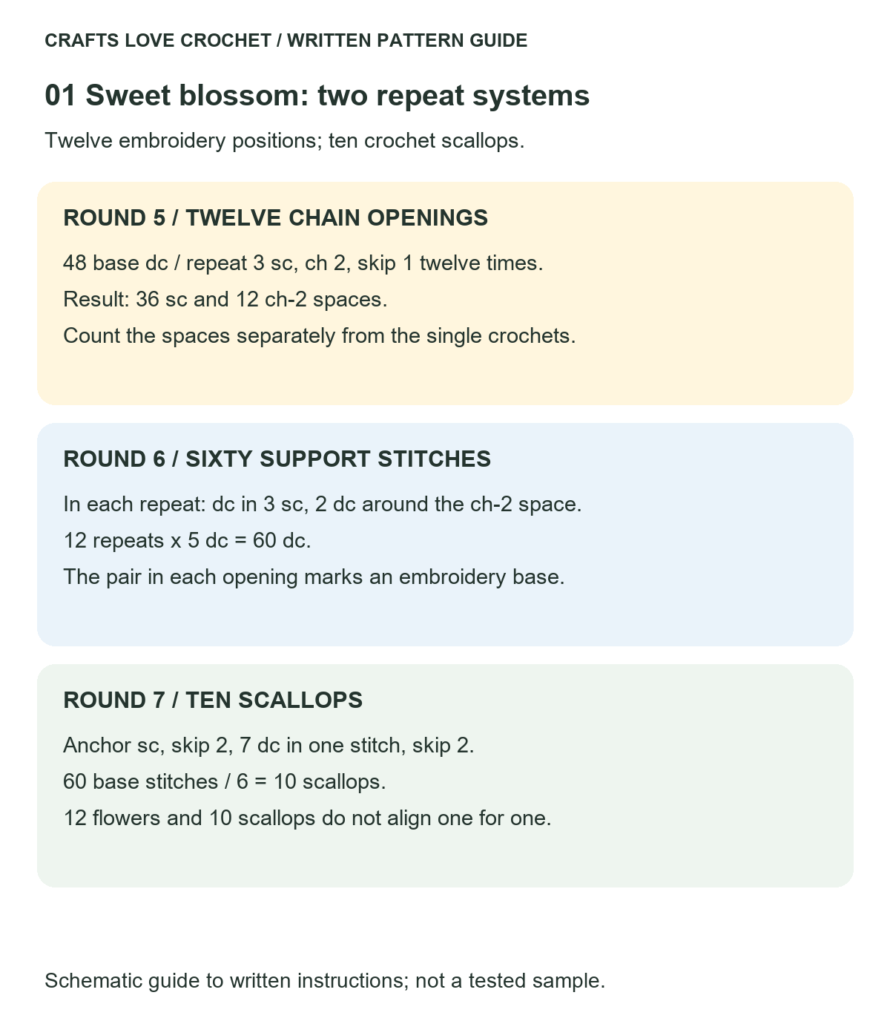
Open this guide at a larger size.
Embroider the Twelve Blossoms
Each motif consists of three long straight stitches arranged like a small fan. The stitches share an outer base, with their other ends pointing toward the center of the doily.
These are individual straight-stitch petals, rather than a densely filled satin-stitch area.
Mark One Flower First
Find a ch-2 opening from Round 5.
Identify the pair of double crochets worked into that opening in Round 6. The lower fabric of this pair provides the outer base of the embroidered flower.
Choose three points toward the center:
- A left petal tip in the fabric of Round 4, slightly left of the opening.
- A middle petal tip in Round 3, approximately aligned with the opening.
- A right petal tip in Round 4, slightly right of the opening.
The middle stitch will be longer than the side stitches.
Anchor the embroidery through the crochet fabric at these positions. Do not place an endpoint in the empty center of a chain opening, where it has no fabric to hold it.
Visual Guide: Three Straight Embroidery Petals
Use the lower fabric of the Round 6 pair as the shared outer base. Place the three tips toward the center without anchoring in an empty chain space.
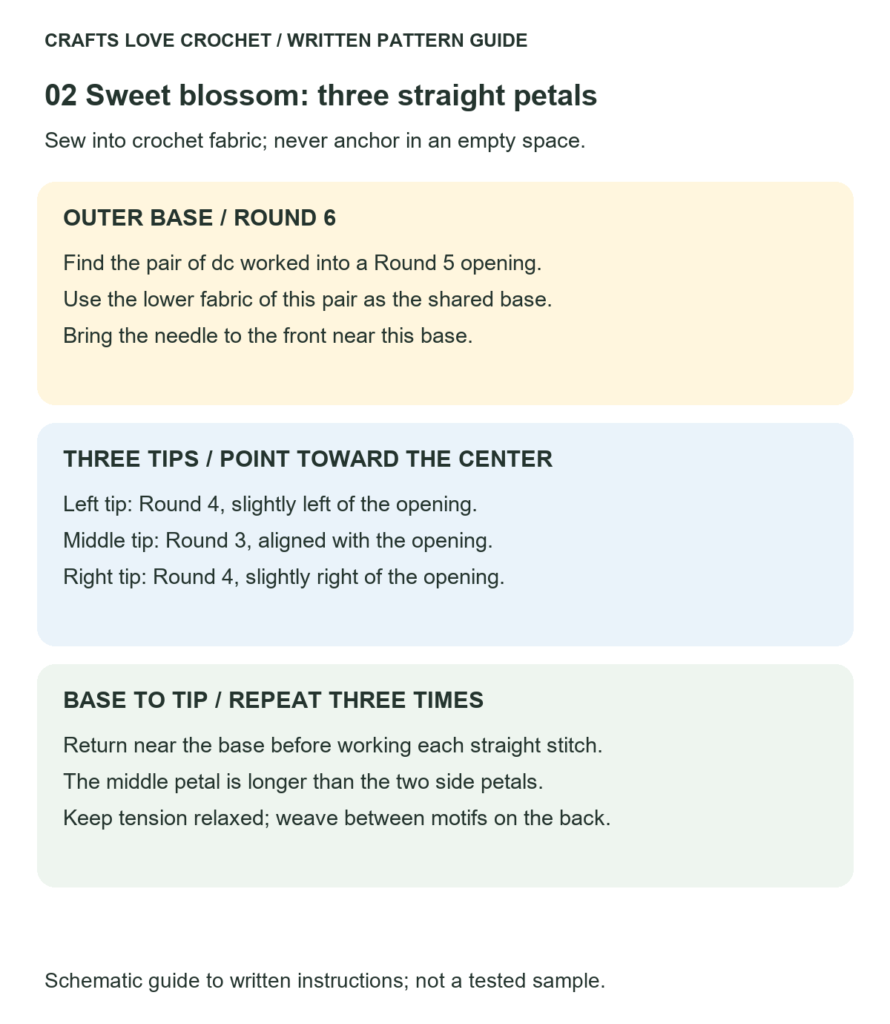
Open this guide at a larger size.
Stitch the First Blossom
Thread a manageable length of Color B onto your yarn needle.
- Secure the starting yarn through stitches on the back, leaving enough tail to weave in firmly.
- Bring the needle to the front at the outer base.
- Insert it at the left petal tip to make the first straight stitch.
- Bring it up again close to the same outer base.
- Insert it at the middle tip to form the longer center petal.
- Return to the outer base and work the right petal in the same way.
Let the embroidery rest against the crochet. Pulling tightly can draw the rounds together and create a pucker.
Repeat Around the Circle
Make one blossom at each of the twelve openings, using the same relative stitch positions.
After the first few motifs, lay the doily down and compare their lengths. Correct any tight embroidery before completing the remaining flowers.
Travel between motifs by weaving through stitches on the back. Avoid leaving long, loose strands across the reverse side.
Secure and weave in every embroidery tail.
Practical Tips for Even Embroidery
Complete one motif before marking all twelve. Its position will show whether the petal lengths suit your yarn and the space available.
Use the crochet rounds as guides. Keeping the side tips in Round 4 and middle tips in Round 3 helps the motifs remain consistent.
Avoid bulky bundles. Begin with one strand of the embroidery yarn. Repeatedly stitching over the same line can create a thick ridge and cover the surrounding crochet.
Check the reverse side. Back strands should lie neatly within the fabric rather than stretching between distant points.
Pause if the base puckers. Loosen or remove the most recent embroidery stitches. Stretching the entire doily will not reliably correct embroidery that has been pulled too tightly.
The embroidery is the distinctive detail of the sweet blossom doily crochet pattern, so leave enough space around each motif for the pale background to remain visible.
Shape and Finish
Follow the yarn’s care instructions. If wet blocking is suitable, dampen the finished doily and press out excess water gently in a towel.
Place it on a blocking surface. Shape the center into a circle, then arrange the ten scallops at even intervals. Use light tension when pinning; do not stretch the embroidered flowers.
Let the piece dry completely before removing the pins.
Blocking can smooth minor unevenness. If the crochet has pronounced waves, cups strongly, or contains an incorrect count, address that issue before trying to shape it.
Use the doily as a decorative display piece, on a shelf, or in a frame. If placing an object on it, check that the embroidered surface does not make the object unstable.
Frequently Asked Questions
Are the flowers crocheted separately?
No. The twelve blossoms are embroidered directly onto the completed crochet base. Each motif contains three straight stitches.
Why does Round 5 have only 36 single crochets?
Each of the twelve repeats contains three single crochets and one chain opening. Twelve groups of three produce 36 single crochets; the openings are counted separately.
Why are there twelve flowers but only ten scallops?
The embroidery follows the twelve openings in Round 5. The border divides the sixty stitches of Round 6 into ten groups of six. The two decorative elements use different spacing.
Can I make the sweet blossom doily crochet pattern larger?
Adding rounds changes the placement and number of openings, the support-round count, and the border repeat. Those sections need recalculating together. A different yarn thickness and matching hook can also change the size, but make and check one complete piece before planning a set.
Can I leave the embroidery off?
Yes. The crochet base and scalloped border are complete before embroidery. Without the stitched motifs, it becomes a simpler decorative mat with a ring of small openings.
Explore Another Floral Detail
For a project whose flower is formed entirely in crochet, try the daisy flower crochet appliqué pattern. Its separate stem and leaves make it suitable for decorating fabric items.
If you would like another table decoration, explore the crochet flower doily pattern for a different arrangement of floral stitches.
When choosing colors for this doily, start with the contrast between the base and embroidery. Two closely related pinks give a subtle effect; a pale base with a deeper flower color makes the individual stitches easier to see.
Share your color combination and finished diameter in the comments—both details help other crocheters plan their own version.