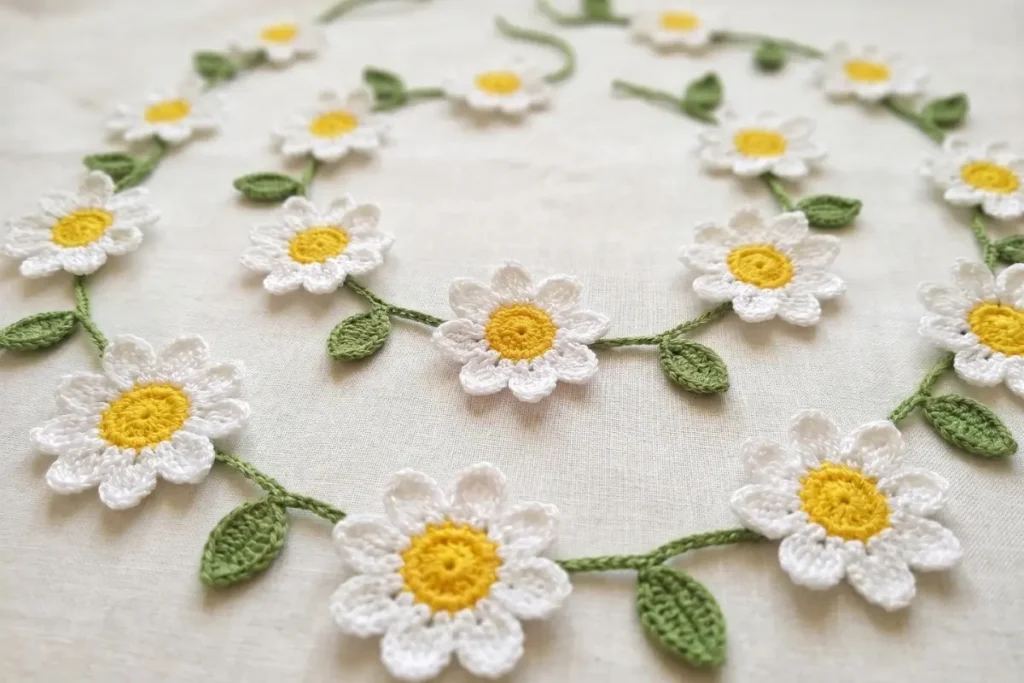
A garland takes shape through spacing as much as through the flowers themselves. Small daisies leave room for the green cord to show, while larger blooms create focal points along the arrangement.
This daisy garland crochet pattern includes two flower sizes, separate leaves, and a cord made to fit your display. Crochet the pieces first, lay them out, and choose the final spacing before sewing anything permanently.
White petals and yellow centers give the garland a familiar daisy palette. Sage green softens the contrast, although a deeper green can make the vine and leaves more visible against a pale wall.
Plan the Length Around Your Flowers
Measure the space where you want to display the garland. Allow for the curve of the hanging cord and leave uncovered sections at both ends for fastening.
For an alternating arrangement, make:
- 5 small daisies
- 4 large daisies
- 12–16 leaves
- 1 green cord
These quantities are a layout suggestion, not a fixed-length formula. Your flower size and spacing determine the finished length.
Begin with one daisy of each size. Place them beside a measuring tape before making the remaining pieces. This helps you decide whether nine flowers suit your available space.
Materials
- DK-weight yarn in golden yellow, white, and sage green.
- A 2.75–3.5 mm crochet hook suited to your yarn and tension.
- Yarn needle.
- Scissors.
- Measuring tape.
- Stitch markers.
- Blocking surface and rust-resistant pins, if needed.
Use similar yarn thicknesses for the centers, petals, and leaves. Cotton is an option when you want clearly defined stitches; choose colors with compatible washing instructions.
Skill level: Confident beginner. You will work joined rounds, stitch along chains, crochet around a foundation chain, and sew the finished motifs onto a cord.
No fixed finished measurements are given because yarn and tension affect both the flower diameter and cord length.
Stitch Terms
This pattern uses US terminology.
| Abbreviation | Meaning |
|---|---|
| ch | chain |
| sl st | slip stitch |
| sc | single crochet |
| hdc | half double crochet |
| dc | double crochet |
| st / sts | stitch / stitches |
| MR | magic ring |
The Craft Yarn Council’s crochet abbreviation guide explains standard abbreviations and includes US–UK comparisons.
Beginning chains and joining slip stitches do not count as stitches in this pattern. Work through both loops unless instructed otherwise.
Daisy Garland Crochet Pattern: Small Flowers
Make five for the suggested arrangement, or adjust the quantity to suit your display.
Yellow Center
Round 1: Make a magic ring. Ch 2 and work 12 dc into the ring. Pull the ring closed and join with a sl st to the first dc. (12 dc)
Round 2: Ch 2. Starting in the same stitch as the join, work 2 dc in each stitch around. Join to the first dc. (24 dc)
Fasten off yellow.
Twelve White Petals
Attach white with a sl st in any stitch of the yellow center.
For the first petal:
- Ch 6.
- Sc in the second ch from the hook.
- Hdc in the next ch.
- Dc in each of the next 2 ch.
- Hdc in the final ch.
- Sl st into the same yellow base stitch where the petal began.
You have worked five stitches along the petal chain.
Skip the next yellow stitch. Sl st into the following yellow stitch to begin the next petal.
Repeat the petal instructions around the center.
After completing the twelfth petal, skip the final unused yellow stitch and join to the starting point. Fasten off.
Count: 12 petals.
Each petal occupies one yellow stitch and is followed by one skipped stitch. Twelve repeats use all twenty-four stitches of the center.
Make the Larger Daisies
Make four for the suggested arrangement.
Yellow Center
Round 1: Make a magic ring. Ch 2 and work 12 dc into the ring. Join to the first dc. (12 dc)
Round 2: Ch 2, work 2 dc in each stitch around. Join. (24 dc)
Round 3: Ch 2, repeat (dc in next st, 2 dc in next st) 12 times. Join. (36 dc)
Fasten off yellow.
Eighteen White Petals
Attach white with a sl st in any stitch of the center.
For each petal:
- Ch 8.
- Sc in the second ch from the hook.
- Hdc in the next ch.
- Dc in each of the next 3 ch.
- Hdc in the next ch.
- Sc in the final ch.
- Sl st into the same yellow base stitch where the petal began.
You have worked seven stitches along the petal chain.
Skip the next yellow stitch. Sl st into the following yellow stitch to start the next petal.
Continue until you have made eighteen petals. After the final petal, skip the last unused yellow stitch and join to the starting point.
Fasten off.
Count: 18 petals.
Flower Checkpoints
| Flower | Final center round | Petal foundation | Petal count |
|---|---|---|---|
| Small | 24 dc | Ch 6 | 12 |
| Large | 36 dc | Ch 8 | 18 |
Weave in the center and petal ends securely. Use separate lengths of matching yarn for attaching the flowers later.
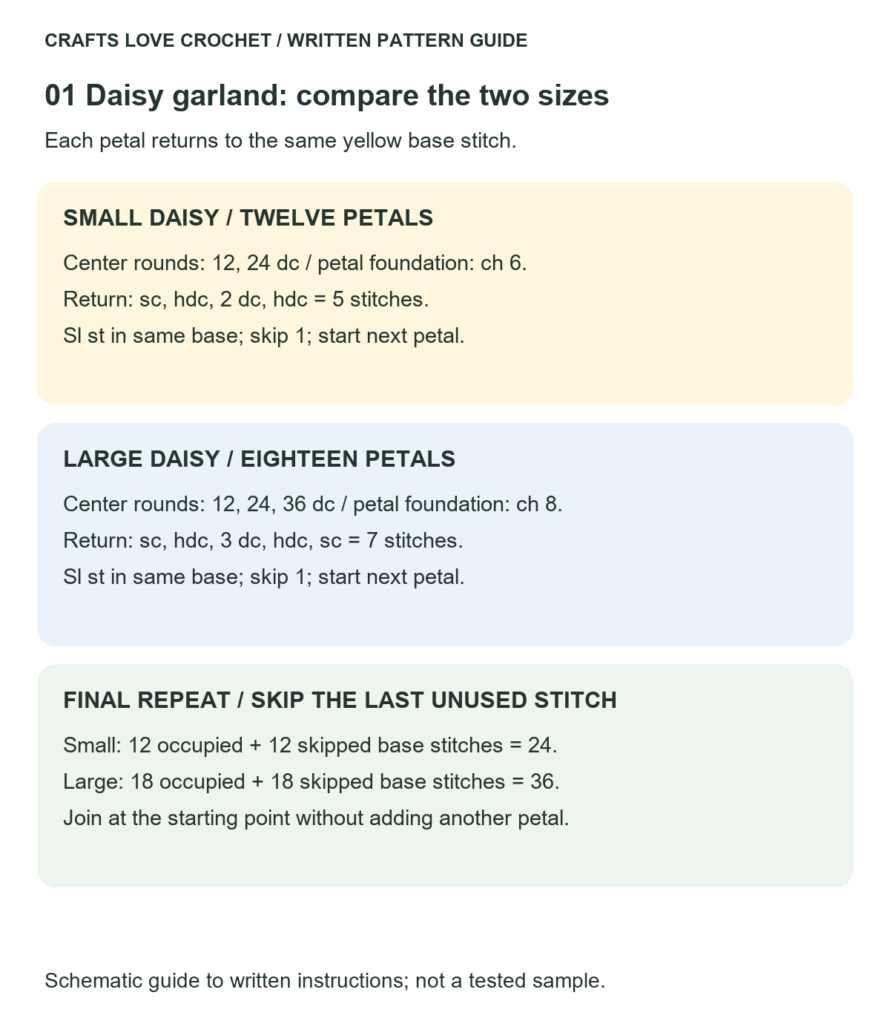
Visual Guide: Small and Large Daisy Petal Counts
Compare the two flower sizes: the smaller daisy has twelve chain petals, and the larger one has eighteen. Each petal returns to its own base stitch.
Open this guide at a larger size.
Crochet the Leaves
Make twelve to sixteen leaves for the suggested arrangement.
With green, ch 10.
First Side
Starting in the second ch from the hook:
- Sc in the next ch.
- Hdc in each of the next 2 ch.
- Dc in each of the next 4 ch.
- Hdc in the next ch.
- Work 3 sc in the final ch.
The three-sc group turns the work around the far end of the foundation chain.
Return Side
Rotate the piece and work along the unused side of the chain. Begin in the chain immediately after the three-sc turning group:
- Hdc in the next ch.
- Dc in each of the next 4 ch.
- Hdc in each of the next 2 ch.
- Sc in the final ch.
Join with a sl st to the first sc. (19 sts)
Fasten off, leaving a sewing tail.
The joined end is the leaf base. The opposite end, containing the three-sc group, is the leaf tip.
Shape the Pieces Before Assembly
Lay the flowers and leaves flat and compare matching pieces.
If blocking is suitable for your yarn, dampen the motifs, arrange the petals individually, and let everything dry completely. Shape gently rather than pulling the petals longer.
If a center has pronounced waves or forms a deep cup, check the count and yarn-and-hook combination. Blocking should refine the shape, not force a distorted piece flat.
Finish this stage before measuring the final layout.
Make a Cord to Fit the Arrangement
Place the flowers in the order you want them to hang. For nine alternating daisies, use:
Small — Large — Small — Large — Small — Large — Small — Large — Small
Leave space between neighboring petals. Add the leaves loosely to see how much green detail you want between flowers.
With green, crochet a foundation chain long enough for the planned arrangement, including uncovered fastening sections at both ends.
Starting in the second ch from the hook, sc in each chain back to the beginning. Fasten off and secure the ends.
The completed cord has one fewer single crochet than the number of foundation chains.
Measure the finished cord without stretching it. Working back along the chain can change its length, so compare it with the layout again before sewing on the motifs.
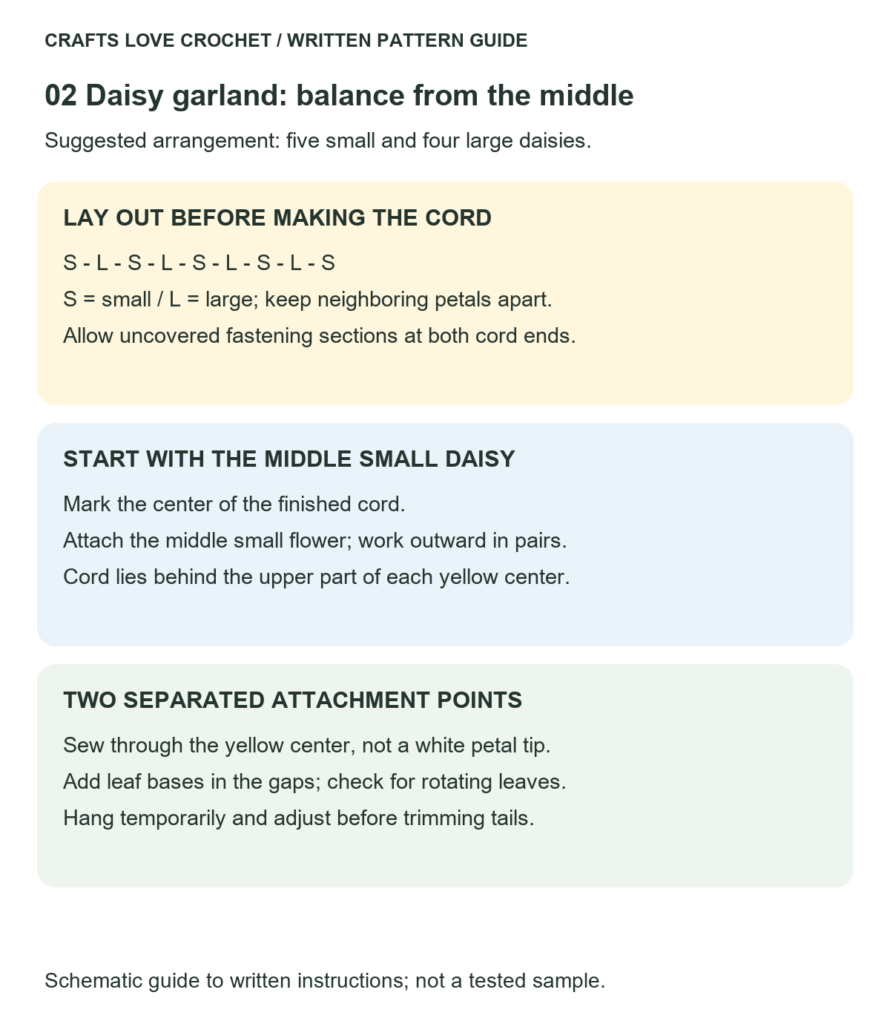
Visual Guide: Balanced Garland Layout and Attachments
Start at the middle small daisy and work outward in pairs. Sew the cord at two separated points behind each yellow center.
Open this guide at a larger size.
Attach the Flowers Without Twisting the Cord
Lay the cord flat and mark its center.
For the nine-flower arrangement, place the middle small daisy at that mark. Work outward in pairs, alternating flower sizes on each side.
Position the cord across the back of the upper portion of each yellow center. Avoid attaching it only to the tip of a white petal.
Using yellow yarn, sew the cord to each center at two separated points. Catch several stitches on the back of the flower while keeping the sewing yarn hidden from the front.
Leave a little flexibility at the join. Pulling the cord tightly into the center can bend the flower.
Temporarily hang the garland before securing every sewing tail. Check whether the flowers face forward and whether the cord sags more than you intended.
Add the Leaves
Place the leaves in the gaps between flowers, with their tips angled outward.
Sew each leaf base to the cord using its green tail. Add a second attachment slightly farther along the lower edge if the leaf rotates or hangs backward.
Vary the angles while keeping the overall weight balanced. A group of several leaves on one side of a gap may pull that section of cord sideways.
Secure and weave in all sewing tails once the arrangement hangs as intended.
Practical Tips for a Balanced Garland
Match flowers within each size. Compare small daisies with small daisies and large ones with large ones. Their different petal counts are intentional.
Keep the petal chains comfortable to work into. Tight chains can make the return stitches difficult and shorten individual petals.
Check the last repeat. A flower with eleven or seventeen petals often indicates that a base stitch was skipped accidentally. Count the yellow round before adjusting the white petals.
Attach through the centers. The petals are decorative and more flexible than the central fabric. Spreading the attachment across the center helps limit twisting.
Assess the whole garland while hanging. A layout that looks balanced on a table can shift when suspended. Make the final placement adjustments before trimming the sewing tails.
These checks are particularly useful when making a longer version of the daisy garland crochet pattern, where small differences in spacing become more noticeable.
Display and Care
Hang the garland from secure supports that suit the wall or shelf surface. Let the cord form a gentle curve rather than pulling it taut.
This is hanging decoration, not a toy. Keep the cord and motifs out of reach of young children.
Follow the yarn’s care instructions when cleaning. Reshape the flowers while damp if appropriate and dry the garland flat, rather than hanging it wet and stretching the cord.
Store it loosely with the flowers lying flat so the petals do not remain sharply folded.
Frequently Asked Questions
Can beginners follow this daisy garland crochet pattern?
Yes, if they can work basic crochet stitches and joined rounds. The separate motifs make it possible to practice one flower before continuing with the full garland.
Can I make a garland using only small daisies?
Yes. Make the small version throughout and choose the number of flowers after checking their finished size against your display space.
Why does each petal end in the same stitch where it started?
Returning to the same yellow stitch creates the petal base. You then skip one yellow stitch and move to the next available stitch before beginning another petal.
Is there a fixed number of chains for the cord?
No. Chain length varies with yarn, hook, and tension. Measure against your finished motifs, then recheck the cord after adding its single-crochet row.
Can the flowers be used separately?
Yes. Omit the cord and sew the flower heads onto another project. For a complete stemmed motif, the daisy flower crochet appliqué pattern includes a stem and two leaves.
Change the Arrangement, Keep the Flowers
You can give this daisy garland crochet pattern a different look by changing the spacing before changing the stitches. Widely spaced flowers leave more of the vine visible; closer spacing creates a fuller floral line.
For another way to display handmade flowers, explore the crochet floral stem bouquet pattern, which arranges separate blooms on supported stems.
Keep a note of your flower quantities, finished cord length, and spacing once you are happy with the result. Those measurements make it easier to create a matching garland later.
Where would you hang yours—along a shelf, across a craft-room wall, or as part of a seasonal display?