Blue and white give a floral doily a clean contrast: the white stitches highlight the flower at the center and return at the outer edge, framing the blue section between them.
This blue daisy crochet doily pattern combines a yellow center, six raised white petals, a circular blue background, and eighteen white scallops. A ring of small eyelets adds an open detail near the border.
The center petals and blue background share the same yellow foundation stitches, but they use different loops. That construction lets the petals sit in front while the blue fabric continues outward behind them.

Understand the Layers Before Starting
The doily is worked in joined rounds without turning.
Round 1 creates the yellow center. Round 2 uses its front loops for the white petals. Round 3 returns to the unused back loops of Round 1 to begin the blue background.
After that, the blue rounds expand outward, followed by the eyelets and the white edging. There are no separate flowers to sew onto the finished piece.
Skill level: Intermediate. The project uses double crochet clusters, front and back loops, regular increases, and a counted shell border.
Yarn and Tools
- Sport-weight cotton yarn in yellow, white, and light blue.
- A 2.5–3.0 mm crochet hook suited to your yarn and tension.
- Yarn needle.
- Scissors.
- Stitch markers.
- A blocking surface and rust-resistant pins, if blocking.
Choose yarns of similar thickness for all three colors. A much thinner border yarn can draw the outer edge inward, while a thicker one can change the scale of the scallops.
Finished diameter depends on your yarn, hook, and tension. Measure the completed piece after finishing rather than relying on a fixed size.
Abbreviations and Special Stitch
This pattern uses US crochet terminology.
| Abbreviation | Meaning |
|---|---|
| ch | chain |
| sl st | slip stitch |
| sc | single crochet |
| hdc | half double crochet |
| dc | double crochet |
| st / sts | stitch / stitches |
| sp | space |
| FLO | front loop only |
| BLO | back loop only |
| MR | magic ring |
For standard terminology and US–UK comparisons, see the Craft Yarn Council’s crochet abbreviation guide.
Three-double-crochet cluster: Work the following three times into the same indicated loop: yarn over, insert hook, yarn over and draw up a loop, yarn over and draw through two loops. Four loops remain on the hook. Yarn over and draw through all four loops.
This cluster forms the raised middle of each white petal.
Beginning and Joining Rounds
For the blue double-crochet rounds, begin with ch 2, which does not count as a stitch. Work the first dc into the same stitch as the join, then join the completed round to its first actual dc.
Do not work into the beginning chain or joining slip stitch. Mark the first dc if it is difficult to identify.
Blue Daisy Crochet Doily Pattern: The Flower Center
Round 1 — Yellow Center
With yellow, make a magic ring.
Ch 1, work 12 sc into the ring, and pull the ring closed. Join with a sl st to the first sc. (12 sc)
Fasten off yellow.
Round 2 — Six White Petals
Work this entire round through the front loops of Round 1 only. Leave all twelve back loops unused.
Attach white with a sl st in the front loop of any yellow stitch.
Work the first petal into that same front loop:
Ch 3, three-double-crochet cluster, ch 3, sl st into the same front loop.
Sl st into the front loop of the next yellow stitch. This is the anchoring stitch between petals.
Sl st into the front loop of the following yellow stitch and make the next petal there.
Continue alternating:
- One stitch containing a complete petal.
- One stitch containing only the anchoring slip stitch.
After the sixth petal, sl st into the final anchoring stitch, then join to the starting point.
Fasten off white. (6 petals)
Each petal and its following anchor use two yellow stitches. Six repeats use all twelve stitches of Round 1.
Visual Guide: Front and Back Loops of the Yellow Center
Keep the white petals in the front loops and use the reserved yellow back loops for the blue background.

Open this guide at a larger size.
Build the Blue Background
Gently move the white petals forward so you can see the unused back loops of the yellow center.
Round 3 — Behind the Petals
Attach blue to any unused back loop of Round 1.
Ch 2. Work 2 dc into each of the twelve reserved back loops. Join to the first dc. (24 dc)
Do not crochet into the white petals or their chain spaces.
Round 4
Ch 2, (dc in next st, 2 dc in next st) 12 times. Join. (36 dc)
Round 5
Ch 2, (dc in next 2 sts, 2 dc in next st) 12 times. Join. (48 dc)
Round 6
Ch 2, (dc in next 3 sts, 2 dc in next st) 12 times. Join. (60 dc)
Round 7
Ch 2, (dc in next 4 sts, 2 dc in next st) 12 times. Join. (72 dc)
Lay the work on a flat surface and check the count before continuing. The raised white petals can sit above the blue fabric, but pronounced cupping or rippling in the background needs attention.
Add the Eyelets
Round 8 — Twelve Openings
Ch 2. Repeat the following sequence 12 times:
2 dc in next st, dc in next 4 sts, ch 1, skip next st.
Join to the first dc.
Count: 72 dc and 12 ch-1 spaces.
Each repeat uses six stitches from Round 7 and produces six dc followed by one chain space.
Keep the ch-1 spaces relaxed enough to remain visible. Do not count them as double crochets.
Round 9 — Return to Solid Stitches
Ch 2. Repeat the following sequence 12 times:
Dc in each of the next 6 dc, 2 dc in the next ch-1 space.
Join to the first dc. (96 dc)
Work around each chain space rather than into the chain itself.
Round 10 — Prepare for the Border
Ch 2, (dc in next 7 sts, 2 dc in next st) 12 times. Join. (108 dc)
Fasten off blue.
Count this round carefully. The border uses groups of six base stitches, and 108 stitches allow eighteen complete repeats.
Blue Round Checkpoints
| Round | Completed count |
|---|---|
| 3 | 24 dc |
| 4 | 36 dc |
| 5 | 48 dc |
| 6 | 60 dc |
| 7 | 72 dc |
| 8 | 72 dc and 12 ch-1 spaces |
| 9 | 96 dc |
| 10 | 108 dc |
Finish with Eighteen White Scallops
Attach white with a sl st in any stitch of Round 10. This is the first anchor.
Work the following sequence 17 times:
- Skip the next 2 blue stitches.
- In the next blue stitch, work (sc, hdc, 5 dc, hdc, sc).
- Skip the next 2 blue stitches.
- Sl st in the next blue stitch to make the next anchor.
You now have 17 scallops. For the eighteenth scallop, skip the next 2 blue stitches, work (sc, hdc, 5 dc, hdc, sc) in the next stitch, skip the final 2 blue stitches, and sl st into the starting anchor. This closes the round; do not work another anchor or skip any more stitches.
Each repeat occupies six blue stitches: an anchor, two skipped stitches, a shell stitch, and two more skipped stitches.
Border count: 18 scallops, with 9 stitches in each scallop.
Fasten off white and weave in the remaining ends.
Visual Guide: Eighteen Scallop Border Repeats
Divide the 108-stitch foundation into eighteen groups of six. Close the last scallop at the original anchor.
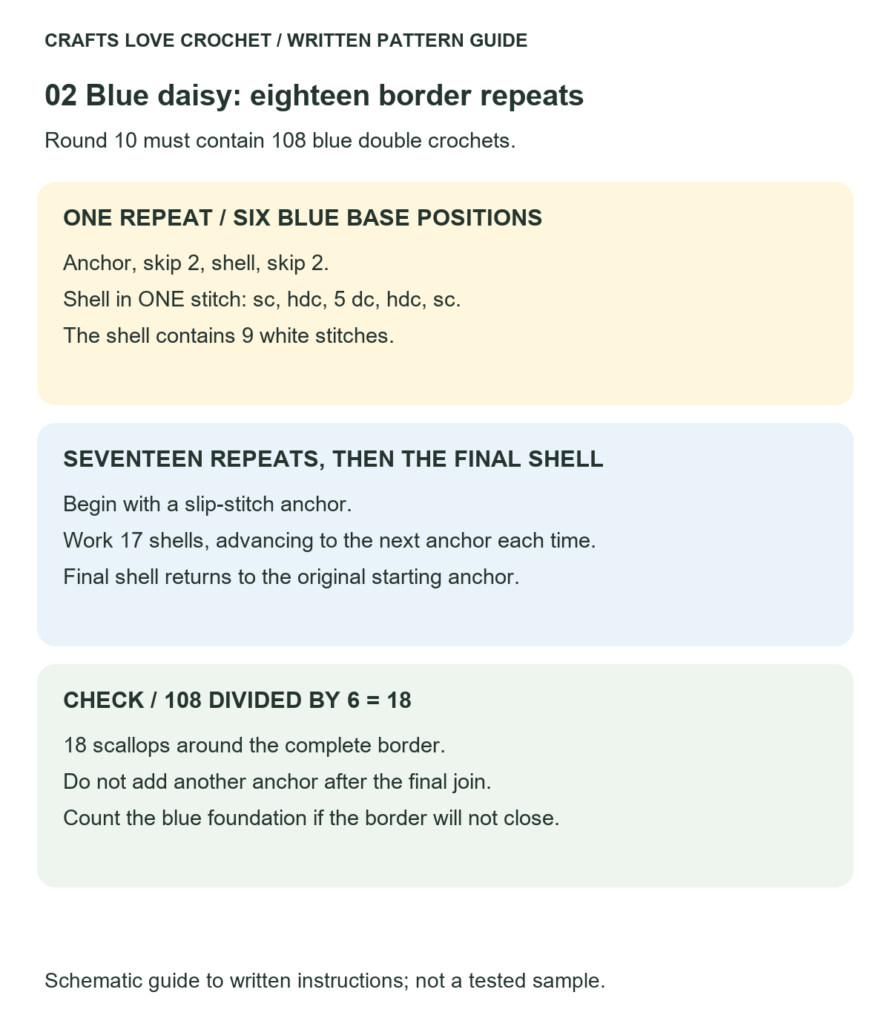
Open this guide at a larger size.
Check the Shape Before Blocking
Set the doily down without stretching it. Check that the eyelets are evenly spaced and that the scallops repeat consistently around the edge.
If the border does not close correctly, count the blue foundation first. Adding an extra shell to fill a gap can hide the original counting error and make the edge uneven.
If the blue fabric cups or develops pronounced waves despite correct counts, reassess the yarn-and-hook combination before continuing. Blocking can refine the fabric, but it should not be used to force a strongly distorted piece flat.
Practical Tips for This Construction
Reserve the correct loops. Working the white petals through both loops removes the attachment points needed for Round 3.
Keep the petal clusters consistent. Each cluster contains three unfinished double crochets closed together. Adding an extra partial stitch changes the petal thickness.
Check Round 8 by repeats. Each section has six dc and one ch-1 space. A marker at the beginning of a repeat can help locate a mistake.
Keep color changes relaxed. A tight first white scallop or a tightly pulled joining slip stitch can distort the edge near the seam.
Distribute the yarn tails. Weave them through different areas rather than building a thick lump behind the flower center.
Block and Care for the Doily
Follow your yarn’s care instructions. If wet blocking is suitable, dampen the doily and gently press out excess water in a towel.
Lay it on a blocking surface. Shape the blue background into a circle, then arrange the scallops evenly. Pin without pulling the fabric hard, keeping the center petals raised rather than stretching them outward.
Allow it to dry completely before removing the pins.
The blue daisy crochet doily pattern includes a textured center, so consider using it as a display mat or framed textile. If placing an object on top, check that it sits steadily rather than rocking on the petals.
Frequently Asked Questions
Is this blue daisy crochet doily pattern suitable for beginners?
It is best for crocheters who can already follow joined rounds and identify front and back loops. The blue increase rounds are repetitive, but the layered center and counted border need closer attention.
Why are there only six white petals?
Each petal is followed by an anchoring stitch. The twelve-stitch yellow center therefore supports six petals and six anchors.
Can I change the colors?
Yes. Keep the yarn thickness consistent across the three colors. A contrasting center and border help the flower and scallops remain visible.
Can I make it larger by adding rounds?
Extra rounds require recalculating the increases and the border foundation. The edging needs a stitch count divisible by six. Using a different yarn thickness and matching hook is another way to change the scale, but the resulting fabric still needs checking.
Does blocking fix an incorrect stitch count?
No. Blocking can smooth small irregularities and help define the eyelets. Missing increases, extra stitches, or misplaced shells should be corrected in the crochet itself.
More Ways to Explore Floral Crochet
If you enjoy the contrast between a yellow center and white petals, the daisy flower crochet appliqué pattern offers a smaller motif with a stem and leaves for sewn decorations.
For another table decoration, explore the crochet flower doily pattern and compare how its floral sections are arranged.
Before making a matching set, complete and finish one doily. Record your yarn, hook size, and finished diameter so you can reproduce its scale.
Would you keep the blue-and-white palette or choose another combination? Share your colors and finished measurements in the comments.
Todos son hermosos