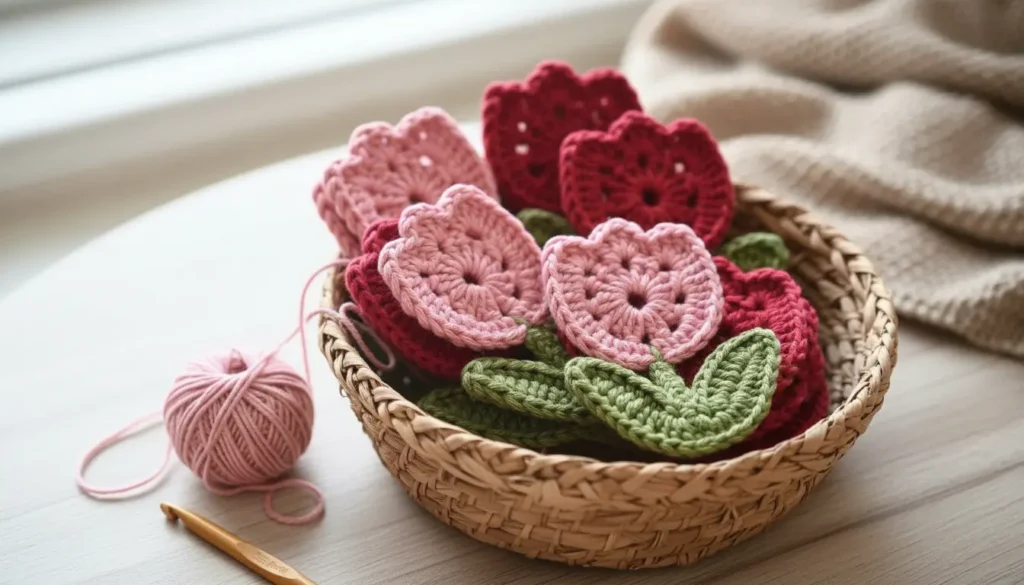
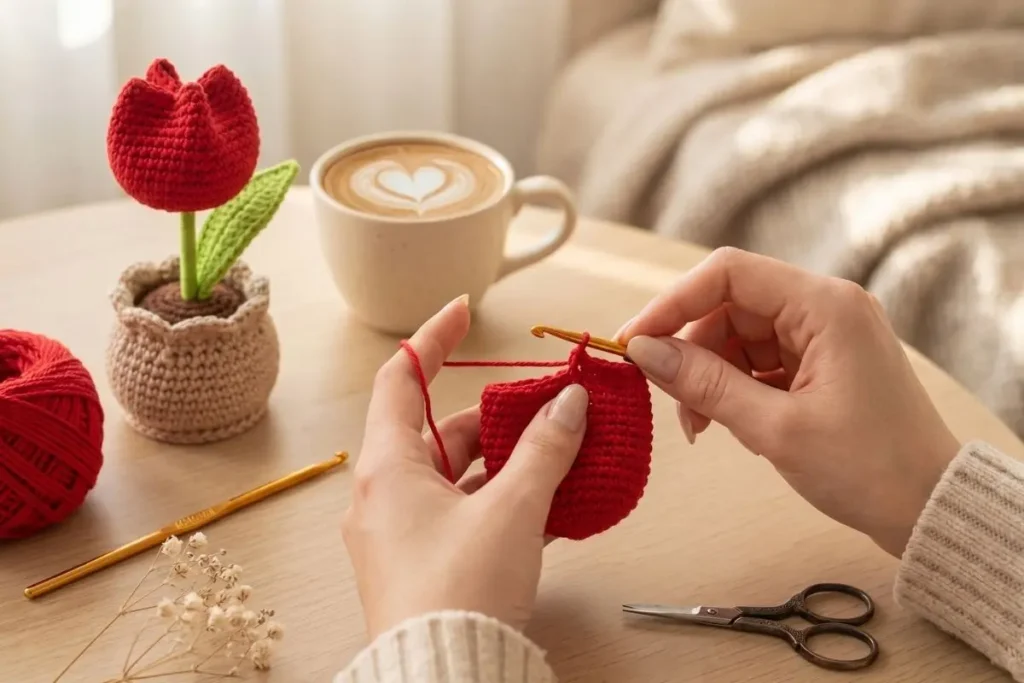
A single flower can carry the whole design when the details around it are carefully placed. In this crochet tulip bouquet applique pattern, a softly rounded pink bud sits against a green leaf, framed by two tapered white panels and a small bow.
The miniature bouquet is assembled from separate pieces, so you can adjust the position of the leaf and wrapper before sewing them together. Its lightly stuffed flower adds dimension, while the flatter backing provides places to attach it to a fabric project.
Use it as a gift topper, a decoration on a fabric pouch, or a floral accent for a handmade card. The raised bud makes it better suited to surfaces where a little depth is welcome.

Before You Pick Up Your Hook
You will make one flower bud, one green flower base, one leaf, two white wrapper panels, and one chain bow.
The bud and its base are worked in continuous rounds. The leaf is worked around both sides of a foundation chain, and the wrapper panels are worked in rows.
Skill level: Confident beginner to intermediate. The main skills are single crochet increases and decreases, working around a chain, and sewing small pieces together.
Size: Finished dimensions depend on the yarn, hook, and arrangement of the pieces. If the bouquet needs to fit a particular card or fabric panel, compare the loose components with that surface before assembly.
Materials
- DK or light worsted-weight yarn in pink, green, white, and light pink.
- A 2.5–3.5 mm crochet hook suited to your yarn and tension.
- Yarn needle.
- Scissors.
- Stitch marker.
- A small amount of fiberfill.
Use yarns of similar thickness for all components. A much heavier wrapper yarn can overwhelm the flower, while a much thinner leaf yarn may produce a leaf that disappears behind it.
Choose a hook that produces close stitches in the bud without making the fabric difficult to work.
Abbreviations
This pattern uses US crochet terminology.
| Abbreviation | Meaning |
|---|---|
| ch | chain |
| sl st | slip stitch |
| sc | single crochet |
| hdc | half double crochet |
| dc | double crochet |
| inc | 2 sc in the same stitch |
| dec | single crochet 2 stitches together |
| st / sts | stitch / stitches |
| MR | magic ring |
For help comparing stitch names, see the Craft Yarn Council’s crochet abbreviation guide.
Beginning chains, turning chains, and joining slip stitches do not count as stitches. Work through both loops unless otherwise stated.
Crochet Tulip Bouquet Applique Pattern: Flower and Base
Pink Flower Bud
Work in continuous rounds without joining or turning. Mark the first stitch of each round.
Round 1: Work 6 sc into a magic ring. Pull the ring closed. (6 sts)
Round 2: Inc in each st around. (12 sts)
Round 3: (Sc in next st, inc) 6 times. (18 sts)
Rounds 4–7: Sc in each st around. (18 sts per round)
Round 8: (Sc in next st, dec) 6 times. (12 sts)
Add a little stuffing. Keep the bud soft enough to compress slightly between your fingers.
Round 9: Sc in each st around. (12 sts)
Fasten off, leaving a sewing tail. Keep the twelve-stitch opening accessible; the green base will close it.
The magic-ring end forms the rounded top of the bud. The open end is the bottom.
Green Flower Base
With green, work in continuous rounds.
Round 1: Work 6 sc into a magic ring. (6 sts)
Round 2: Inc in each st around. (12 sts)
Round 3: Sc in each st around. (12 sts)
Fasten off, leaving a long sewing tail.
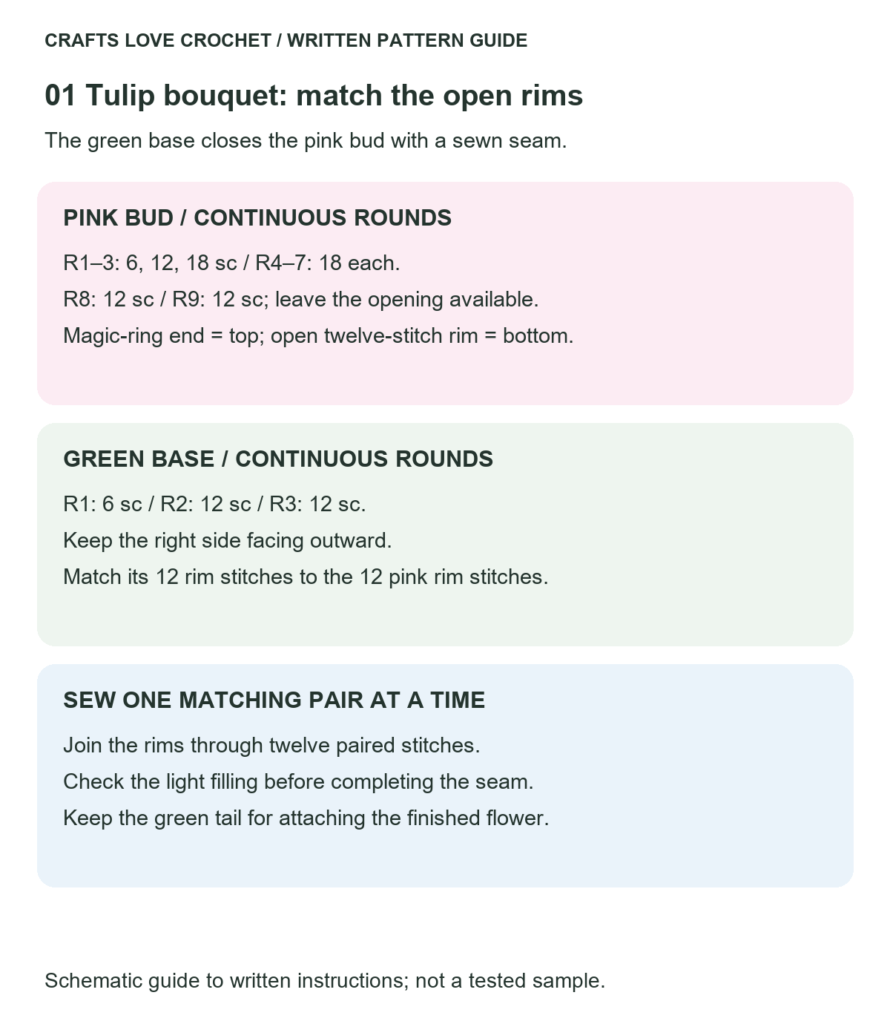
Place the open rim of the green base against the open rim of the pink bud, with the right sides of both pieces facing outward. Match the twelve green stitches to the twelve pink stitches.
Sew the rims together one stitch pair at a time. Before completing the seam, check the stuffing and add a little more only if needed.
Close the seam fully. Keep the remaining green tail for attaching the flower to the leaf and wrapper.
Visual Guide: Matching the Open Bud and Sepal Rims
Leave the twelve-stitch bud rim and twelve-stitch sepal rim open. Match them stitch for stitch when sewing the lightly filled bud into place.
Open this guide at a larger size.
Make the Leaf
The leaf is worked as one continuous oval around the foundation chain.
With green, ch 11.
First Side
Starting in the second chain from the hook:
- Sc in the next 2 ch.
- Hdc in the next 3 ch.
- Dc in the next 4 ch.
- Work 3 dc in the final ch.
Mark the middle dc of the three-dc group. This marks the far tip of the leaf.
Second Side
Rotate the work to use the remaining loops along the opposite side of the foundation chain.
Beginning in the chain immediately after the three-dc turning group:
- Dc in the next 4 ch.
- Hdc in the next 3 ch.
- Sc in the final 2 ch.
Join with a sl st to the first sc. (21 sts)
There are nine stitches along each side and three stitches at the far end.
Leaf Border
Ch 1. Sc in each stitch around, except at the marked tip, where you work (sc, ch 2, sc) in the same stitch.
Join to the first sc. (22 sc and one ch-2 space)
Fasten off with a sewing tail.
The joined end is the leaf base. The ch-2 space marks the upper tip.
For a center vein, use green yarn to make small running stitches along the foundation chain. Keep the embroidery relaxed; a tight strand can draw the ends together and make the leaf curl.
Crochet the Two Wrapper Panels
These panels begin at the wide upper edge and narrow toward the bottom of the bouquet.
With white, ch 16.
Row 1: Sc in the second ch from the hook and in each remaining ch. (15 sts)
For every following row, turn and ch 1 before working the instructions. The turning chain does not count as a stitch.
| Row | Instructions | Count |
|---|---|---|
| 2 | Sc in each st | 15 |
| 3 | Dec, sc in next 11 sts, dec | 13 |
| 4 | Sc in each st | 13 |
| 5 | Dec, sc in next 9 sts, dec | 11 |
| 6 | Sc in each st | 11 |
| 7 | Dec, sc in next 7 sts, dec | 9 |
| 8 | Sc in each st | 9 |
| 9 | Dec, sc in next 5 sts, dec | 7 |
| 10 | Sc in each st | 7 |
| 11 | Dec, sc in next 3 sts, dec | 5 |
| 12 | Sc in each st | 5 |
| 13 | Dec, sc in next st, dec | 3 |
| 14 | Sc in each st | 3 |
| 15 | Dec, sc in final st | 2 |
Fasten off, leaving a long sewing tail.
Make a second identical panel. Lay them together to compare their lengths before assembling the bouquet.
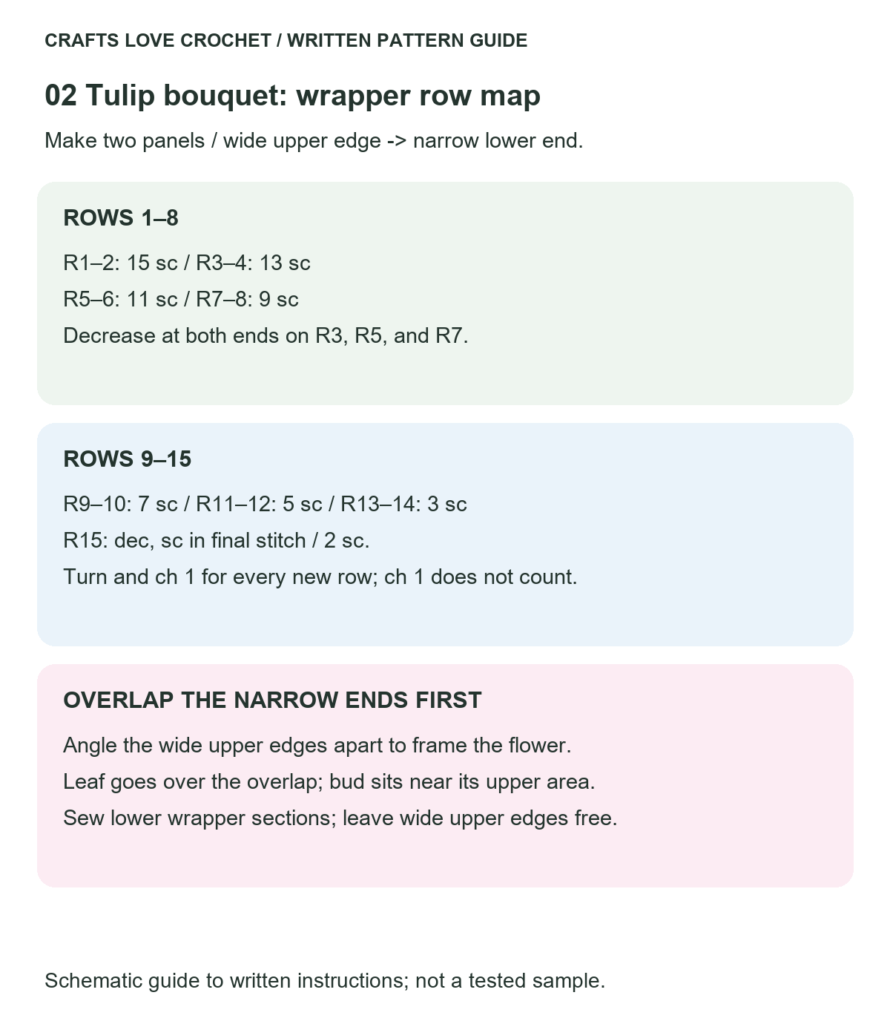
Visual Guide: Wrapper Panel Taper and Arrangement
Keep the wide wrapper ends at the top and overlap the narrow ends beneath the stems. Use the row counts to compare both panels before assembly.
Open this guide at a larger size.
Arrange the Bouquet Before Sewing
This stage determines how much of the leaf and wrapper remains visible.
- Place the two white panels on a flat surface with their wide edges at the top and narrow ends pointing downward.
- Overlap the lower sections. Angle the wide ends slightly apart to create an open wrapper.
- Lay the leaf over the overlapping center, with its tip extending above the wrapper.
- Place the flower toward the upper part of the leaf, leaving some green visible beside or behind the bud.
Adjust the overlap until the arrangement suits the surface where you plan to attach it. Avoid pulling the panels tightly around the flower; the wrapper should frame it.
Sew the Wrapper and Leaf
Use a white tail to join the overlapping lower sections of the wrapper with small stitches. Leave the wide upper edges free.
With green yarn, attach the lower part of the leaf to the central overlap. Catch stitches from both wrapper panels where possible so the leaf is supported by the complete backing.
Keep the stitches relaxed enough that the wrapper does not pucker.
Attach the Tulip
Sew through the green flower base and into the leaf. Where the base overlaps the wrapper, add stitches through that layer as well.
Attach the base at more than one point so the bud does not swivel. If the flower tips forward, add a small hidden tack between the lower back of the pink bud and the leaf.
The bud should remain raised at the front without hanging loosely from a single attachment.
Add the Bow
With light pink yarn, ch 20.
Fasten off, leaving tails long enough to secure and weave in.
Tie the chain into a small bow. Place it across the narrow lower section of the wrapper and sew through the center knot to hold it in position.
Check the loop sizes before securing the sewing yarn. Weave in the ends rather than cutting them close to the knot.
Finishing Details That Make a Difference
Keep the flower lightly stuffed. A firm ball of filling can push the stitches apart and make the bud look rounder. Use small pieces of fiberfill and distribute them evenly.
Count the leaf before adding its border. You should have 21 stitches. If the total differs, check the three-dc turning group and make sure the return side begins in the next chain.
Watch the first and last stitches of the wrapper rows. Missing an edge stitch creates unintended decreases. Count each row before turning, especially near the narrow bottom.
Check the back as well as the front. Spread woven ends through different areas instead of concentrating them beneath the flower. A smoother backing is easier to sew onto fabric.
Shape the flat pieces separately. If your yarn permits damp blocking, shape the leaf and wrapper panels before assembly and let them dry completely. Avoid pressing the stuffed bud flat.
These checks help keep the separate parts of the crochet tulip bouquet applique pattern balanced without relying on a fixed finished size.
Ways to Use the Finished Appliqué
For a fabric pouch or tote, sew around the lower wrapper and add discreet attachment stitches behind the leaf and flower base. Supporting the upper section helps prevent it from catching or flopping forward.
For a handmade card, position the bouquet on the front and secure it with stitching through suitable card stock or an adhesive intended for both yarn and paper. Keep adhesive away from the visible edges.
As a gift decoration, attach it to a ribbon or removable fabric band so the recipient can keep the bouquet after opening the package.
If you would prefer an open flower for a similar project, explore the daisy flower crochet appliqué pattern. Its separate flower, stem, and leaves offer a different arrangement for a floral fabric decoration.
Frequently Asked Questions
Is this crochet tulip bouquet applique pattern completely flat?
No. The leaf and wrapper are relatively flat, but the flower contains a little stuffing. It is a dimensional appliqué, so choose a placement where the raised bud will not be compressed.
Can I use another yarn weight?
Yes, but the finished dimensions will change. Use similar yarn thicknesses throughout the project and choose a hook that keeps the bud stitches close enough to contain the filling.
Does the flower need a separate closing round?
No. The pink bud ends with twelve stitches, and the green base also has twelve stitches around its opening. Sewing those two rims together closes the flower.
Can I turn the bouquet into a keychain?
It would need an additional reinforced attachment loop and a check of all joining seams. The construction here is intended primarily for an appliqué; attaching a ring through one crochet stitch would place too much strain on that point.
Can I make it without stuffing?
You can omit the filling for a softer, flatter decoration, although the flower will look less rounded. Still sew the green base to the pink opening to finish the bud neatly.
A Small Bouquet or a Larger Arrangement?
For another version of this small bouquet, change the bud color while keeping the wrapper neutral. Yellow with cream, deep pink with white, or pale lavender with green can give the same construction a different character.
If you want flowers for a vase rather than a sewn decoration, the crochet floral stem bouquet pattern explores separate flower heads, leaves, and supported stems.
Where will your miniature tulip bouquet go—a gift, a card, or a fabric project? Share your color choice and how you attached it in the comments.