This tulip pot amigurumi crochet pattern combines three pink flowers, green leaves, and a smiling beige planter with two little legs. The flowers and leaves are made separately, allowing you to arrange the bouquet before attaching it to the pot.
The construction includes a crocheted top panel that closes the planter and provides attachment points for the stems. The folded rim covers the joining seam, while the embroidered face keeps the expression simple.
This version uses soft, unreinforced stems. They can bend under the weight of the flowers, so the arrangement should be assessed before the final seams are secured.

Materials for the Tulip Pot Amigurumi Crochet Pattern
- Super bulky chenille or plush yarn, Category 6:
- Beige for the pot, top panel, and legs.
- Pink for the tulips.
- Green for the stems and leaves.
- Smooth black yarn or embroidery thread for the face.
- A 5.5–6.5 mm crochet hook as a starting range.
- Polyester fiberfill.
- A yarn needle.
- Stitch markers.
- Scissors.
Use yarns of similar thickness for the main pieces. Choose a hook that produces fabric without visible stuffing gaps while allowing you to work comfortably.
Finished dimensions and yarn quantities depend on the materials and tension used. Measure the completed components rather than relying on a fixed finished-size estimate.
The instructions use embroidered eyes and contain no wire. This project is intended as a decorative arrangement.
Abbreviations and Techniques
This tulip pot amigurumi crochet pattern uses US terminology.
- MR: magic ring.
- ch: chain.
- sc: single crochet.
- inc: work 2 sc into one stitch.
- dec: decrease two stitches into one.
- sl st: slip stitch.
- st / sts: stitch / stitches.
- BLO: back loop only.
- FLO: front loop only.
- FO: fasten off.
For an invisible decrease in the round, insert the hook through the front loops of the next two stitches, yarn over and pull through both front loops, then yarn over and pull through the remaining two loops.
For the turned petal rows, use a regular single crochet decrease: draw up a loop in each of the next two stitches, then yarn over and pull through all three loops.
You can consult the Craft Yarn Council’s crochet abbreviations and US–UK comparison if you need to check terminology.
Construction Notes
Work the circular components in continuous rounds unless instructed otherwise.
Do not join or add a beginning chain between continuous rounds. Mark the first stitch and move the marker as each round is completed.
Numbers in parentheses indicate the stitch count at the end of the round or row.
For example, “(2 sc, inc) six times” means working one sc into each of the next two stitches, followed by two sc into the next stitch, and repeating that sequence six times.
Make:
- One pot.
- One top panel.
- Two legs.
- Three flower heads.
- Three stems.
- Four leaves.
Tulip Pot Amigurumi Crochet Pattern: The Planter
Use beige yarn.
Base
- Round 1: Work 6 sc into a MR. (6)
- Round 2: Inc in every stitch. (12)
- Round 3: (1 sc, inc) six times. (18)
- Round 4: (2 sc, inc) six times. (24)
- Round 5: (3 sc, inc) six times. (30)
- Round 6: (4 sc, inc) six times. (36)
- Round 7: (5 sc, inc) six times. (42)
- Round 8: (6 sc, inc) six times. (48)
- Round 9: Working in BLO, sc in every stitch. (48)
Round 9 leaves the front loops visible around the base and establishes the transition to the pot walls.
Pot Body
- Rounds 10–20: Sc in every stitch. (48 per round)
These are 11 rounds without increases.
Keep the pot unstuffed while making the face and attaching the legs so you can reach the inside.
Folded Rim
- Round 21: Working in FLO, repeat (3 sc, inc) 12 times. (60)
- Rounds 22–24: Working through both loops, sc in every stitch. (60 per round)
- Round 25: Work one loose sl st into each stitch. (60 slip stitches)
Fasten off and weave in the tail.
Fold the rim outward. The unused back loops of Round 20 remain available on the inside for attaching the top panel.
Top Panel — Make One
Use beige yarn and the same hook used for the pot.
- Round 1: Work 6 sc into a MR. (6)
- Round 2: Inc in every stitch. (12)
- Round 3: (1 sc, inc) six times. (18)
- Round 4: (2 sc, inc) six times. (24)
- Round 5: (3 sc, inc) six times. (30)
- Round 6: (4 sc, inc) six times. (36)
- Round 7: (5 sc, inc) six times. (42)
- Round 8: (6 sc, inc) six times. (48)
Sl st into the next stitch to finish. This slip stitch does not add to the count.
Fasten off, leaving a long sewing tail.
Place the panel inside the pot opening before attaching the flowers. Its 48 edge stitches will be sewn individually to the 48 unused back loops of Round 20.
Check the physical fit as well as the stitch count. The panel should not need strong stretching or gather into folds.
Legs — Make Two
Use beige yarn.
- Round 1: Work 6 sc into a MR. (6)
- Round 2: Inc in every stitch. (12)
- Rounds 3–5: Sc in every stitch. (12 per round)
- Round 6: (4 sc, dec) twice. (10)
- Rounds 7–12: Sc in every stitch. (10 per round)
Stuff the lower part of each leg. Leave the final section lightly filled so the opening can be flattened.
Fasten off with a sewing tail.
Flatten the ten-stitch opening into five opposing stitch pairs. Sew through each pair to close it.
Tulip Flower Heads — Make Three
Use pink yarn.
Flower Body
- Round 1: Work 6 sc into a MR. (6)
- Round 2: Inc in every stitch. (12)
- Round 3: (1 sc, inc) six times. (18)
- Round 4: (2 sc, inc) six times. (24)
- Rounds 5–8: Sc in every stitch. (24 per round)
Fasten off this working strand and secure it.
Add a small amount of stuffing. Keep the upper section soft enough to flatten without stretching the stitches.
Close the Opening
Flatten the opening so that 12 stitches on the front align with 12 stitches on the back.
Join pink yarn at one end.
Ch 1, then work 12 sc across the opening, inserting the hook through both loops of one front stitch and both loops of its corresponding back stitch for each sc.
This joins all 24 opening stitches into a closed edge of 12 sc.
Fasten off.
First Petal Point
Join pink yarn at one end of the closed edge.
- Row 1: Ch 1, sc in the first six stitches of the closed edge. Leave the remaining six unworked. (6)
- Row 2: Ch 1, turn. Dec, 2 sc, dec. (4)
- Row 3: Ch 1, turn. Dec twice. (2)
Beginning chains do not count as stitches.
Fasten off and weave in the ends.
Second Petal Point
Join pink yarn in the first of the six unused stitches on the closed edge.
- Row 1: Ch 1, sc in each of these six stitches. (6)
- Row 2: Ch 1, turn. Dec, 2 sc, dec. (4)
- Row 3: Ch 1, turn. Dec twice. (2)
Fasten off and weave in the ends.
The flower has a closed stuffed body with two tapered points above it. Repeat for all three heads.
Visual Guide: Two Points on Each Tulip Head
Flatten the opening into twelve stitch pairs, then use six closing-edge stitches for each independently worked point.
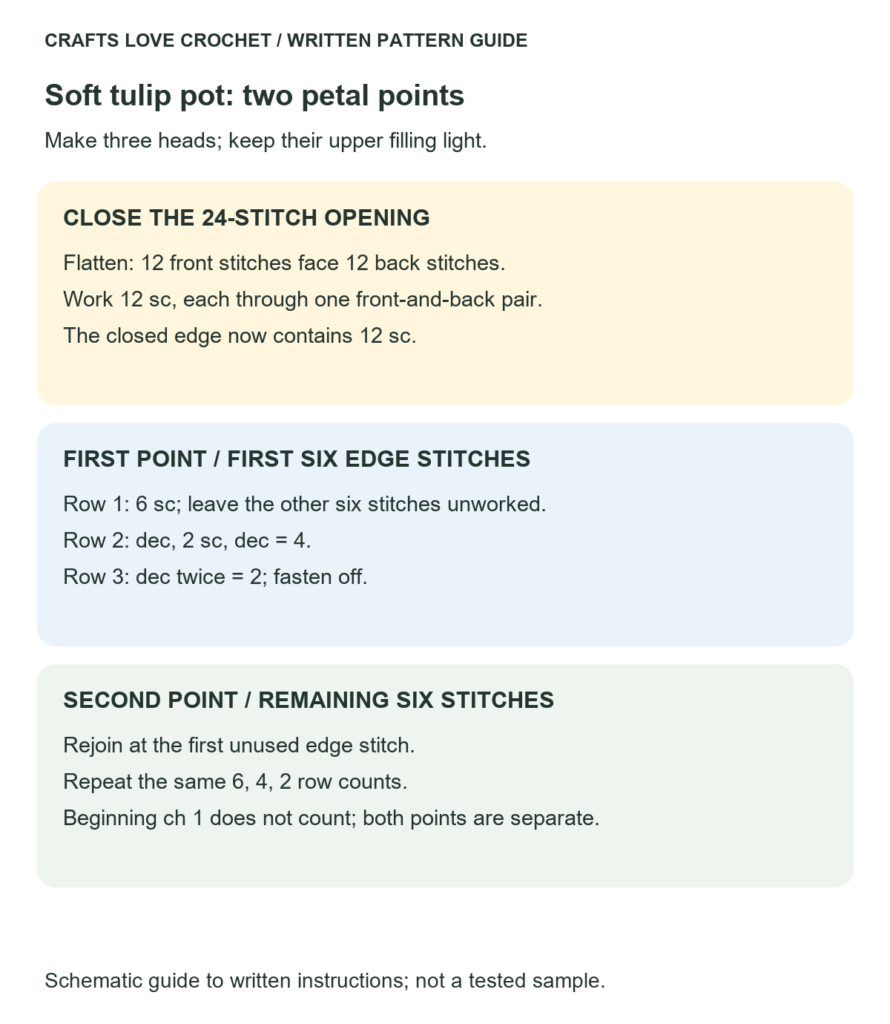
Open this guide at a larger size.
Stems — Make Three
Use green yarn.
- Round 1: Work 6 sc into a MR. (6)
- Rounds 2–14: Sc in every stitch. (6 per round)
Add small amounts of stuffing as you work. Avoid forcing a large piece of filling down the narrow tube.
Fasten off with a sewing tail, leaving the final opening unclosed.
Sew the six-stitch opening around the underside of a flower head, centered over its starting ring. Catch several stitches on the head so the connection is not concentrated at a single point.
These stems remain flexible. Stuffing does not provide the same support as a rigid internal structure.
Leaves — Make Four
Use green yarn.
- Round 1: Work 6 sc into a MR. (6)
- Round 2: Inc in every stitch. (12)
- Round 3: Sc in every stitch. (12)
- Round 4: (4 sc, dec) twice. (10)
- Round 5: Sc in every stitch. (10)
- Round 6: (3 sc, dec) twice. (8)
- Round 7: Sc in every stitch. (8)
Fasten off with a sewing tail.
Leave the leaf unstuffed and flatten it.
Align the eight opening stitches into four pairs. Sew through the pairs to close the narrow end. This closed end is the leaf base used for attachment.
Assembling the Tulip Pot Amigurumi Crochet Pattern
Add the Face
With the pot still open and unstuffed, mark two eye positions between Rounds 14 and 15, with eight stitch columns between their centers.
Embroider two small eyes with black yarn or embroidery thread.
Add a curved mouth below and between them. Secure the ends inside the pot without pulling the fabric into deep indentations.
Attach the Legs
Position the closed ends of the legs across the lower front of the pot, around Rounds 10–11.
Leave approximately eight stitch columns between the inner edges of the two attachment seams.
Sew each five-stitch closed edge to the pot. Check from the front that both legs hang at the intended angle before securing the tails.
Arrange the Flowers on the Panel
Keep the top panel separate from the pot during this step.
Place the closed lower ends of the three stems on the panel in a triangular arrangement: one toward the back center and two toward the front sides.
Leave the outermost panel round clear for the closing seam.
Sew around the lower end of each stem, catching the sides of its first few rounds and several stitches of the panel. Do not rely on a single stitch through the starting ring.
Check the arrangement with the panel resting over the pot. The heads may lean because the stems are soft.
Where stems naturally touch, they can be stitched together to form a connected cluster. If the heads still collapse or pull the panel sharply upward, stop and reassess the stem length or arrangement before closing the pot.
Attach the Leaves
Arrange two leaves on each side of the stem cluster.
Sew each leaf’s closed base to the panel or the lower part of a stem, keeping the panel’s outer round clear.
If needed, add a few stitches between the side of a leaf and a neighboring stem to hold its angle.
Visual Guide: Panel Under the Folded Pot Rim
Attach the three soft stems to the panel first, keeping its outer round clear for sewing into the unused back loops beneath the folded rim.
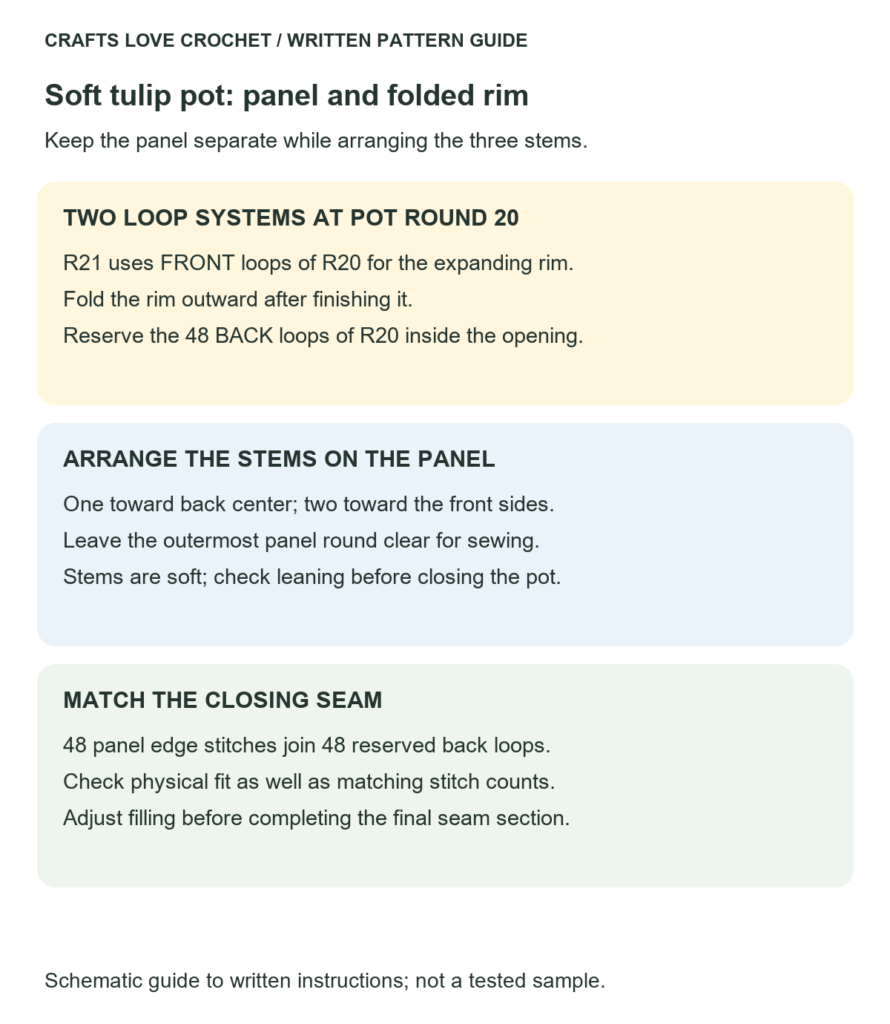
Open this guide at a larger size.
Stuff and Close the Pot
Add filling gradually, distributing it around the base and walls. Avoid packing the bottom into a rounded bulge.
Position the top panel inside the folded rim.
Using its sewing tail, join each of the panel’s 48 edge stitches to one unused back loop of Pot Round 20.
Pause before closing the final section to adjust the stuffing. Complete the seam and secure the tail.
Fold the rim outward again to cover the join.
Practical Tips
Move the Marker Every Round
Chenille can hide stitch tops. Keep the first stitch marked, and check the count at the end of each increase or decrease round.
Test the Panel Before Decorating It
A matching count is necessary, but tension also affects the fit. Check the plain panel inside the pot before sewing on the flower cluster.
Stuff Before Closing the Flower
The 12-stitch closing row seals the head. Add and distribute the filling before working that row.
Keep the Bouquet Flexible
Do not expect long, soft tubes to hold heavy plush heads rigidly upright. Assess one assembled head and stem before completing all three.
Check the Base on a Flat Surface
Place the pot on the surface where it will be displayed. Adjust the stuffing and bouquet position if it rocks or tips.
More Crochet Flower Projects
For a different potted-flower construction, explore the Tulip Flower in Pot Amigurumi Crochet Pattern.
If you would rather work on a flat floral embellishment, visit the Sunflower Crochet Applique Pattern, which combines a circular center, individual petals, and a separate leaf.
Frequently Asked Questions
Is This Tulip Pot Amigurumi Crochet Pattern Suitable for Beginners?
The stitches are mostly single crochet, but the project also involves working through paired stitches, shaping short rows, and assembling several components. Familiarity with basic amigurumi construction is useful.
Why Does the Top Panel Have 48 Stitches When the Rim Has 60?
The panel attaches to the 48 unused back loops of Pot Round 20. The 60-stitch rim is an outer decorative section and is not the attachment edge.
Are the Flower Heads Left Open?
No. The 24-stitch opening is closed with 12 sc worked through opposing stitch pairs. The two petal points are then worked onto that closed edge.
Do the Stems Contain Wire?
No. This version uses crocheted, lightly stuffed stems. Their flexibility affects the final arrangement, so assess their support before completing the pot.
How Large Will the Finished Planter Be?
The dimensions depend on the yarn, hook, tension, and flower arrangement. Measure the completed sample to establish its height and width.
Finishing Your Tulip Planter
Shape the leaves and flower heads gently, then check the seams and the balance of the pot.
Keep a record of the yarn, hook, finished measurements, and any adjustments made during assembly. Those notes are especially helpful when making a second planter.
Share your color choices and construction observations in the comments. If a step needs clarification, include the component and round number so the question can be addressed precisely.