The red wings reveal this little character’s ladybug costume, while a brown hood frames the beige face. Six black spots, two soft antennae, and an optional bow complete the outfit.
This ladybug doll amigurumi pattern is worked in separate pieces. The head and body are stuffed, the wings are folded without filling, and the hood is fitted before being sewn in place.
The placement of the wings makes a noticeable difference. Keeping their straight edges close together suggests a closed ladybug shell; angling the lower ends slightly apart gives the doll a more open silhouette.

Gather Your Materials
- Worsted-weight yarn in brown, beige, red, and black.
- A 2.5–3 mm crochet hook, if suitable for your chosen yarn.
- Polyester fiberfill.
- Yarn needle.
- Stitch marker.
- Scissors.
- Optional pink embroidery yarn for cheeks.
Black yarn is used for both the wing spots and embroidered eyes. No wire is needed for the antennae.
Choose a hook that produces close stitches without making the work difficult. Worsted yarn varies in thickness, so check the fabric rather than relying on the hook size alone.
Skill level: Intermediate, mainly because of the small pieces and their assembly.
Finished size: Depends on yarn, hook, stuffing, and tension. Measure the completed doll rather than relying on a fixed height.
Stitch Terms and Working Notes
US crochet terminology is used throughout.
| Abbreviation | Meaning |
|---|---|
| MR | magic ring |
| ch | chain |
| sc | single crochet |
| inc | 2 sc in the same stitch |
| dec | single crochet decrease |
| sl st | slip stitch |
| st / sts | stitch / stitches |
An invisible decrease is useful on the stuffed pieces: insert the hook under the front loops of the next two stitches, draw yarn through those loops, then complete the single crochet.
For standard terminology, refer to the Craft Yarn Council’s crochet abbreviation guide.
Work in continuous rounds without joining unless instructed otherwise. Mark the first stitch of every round. Beginning chains and joining slip stitches do not count as stitches.
Ladybug Doll Amigurumi Pattern: Head and Face
With beige yarn:
| Round | Instructions | Count |
|---|---|---|
| 1 | 6 sc in MR | 6 |
| 2 | Inc in each st | 12 |
| 3 | (Sc, inc) 6 times | 18 |
| 4 | (Sc in next 2 sts, inc) 6 times | 24 |
| 5 | (Sc in next 3 sts, inc) 6 times | 30 |
| 6 | (Sc in next 4 sts, inc) 6 times | 36 |
| 7–12 | Sc in each st | 36 |
Embroider the Eyes
Choose the front of the head and mark two eye positions between Rounds 9 and 10, leaving approximately six or seven stitches between them.
Make small black straight stitches for each eye. Keep the embroidery against the surface without pulling the fabric inward.
Secure the ends inside the head while the opening is accessible. You can add a small mouth or pink cheek stitches if desired.
Close the Head
| Round | Instructions | Count |
|---|---|---|
| 13 | (Sc in next 4 sts, dec) 6 times | 30 |
| 14 | (Sc in next 3 sts, dec) 6 times | 24 |
| 15 | (Sc in next 2 sts, dec) 6 times | 18 |
| 16 | (Sc, dec) 6 times | 12 |
Add stuffing gradually and shape the head. Fill evenly without stretching the stitches apart.
Round 17: Dec 6 times. (6 sts)
Fasten off. Thread the tail through the front loops of the final six stitches, draw the opening closed, and secure the end.
The magic-ring end is the top of the head. The gathered closure is the underside.
Brown Body
With brown:
| Round | Instructions | Count |
|---|---|---|
| 1 | 6 sc in MR | 6 |
| 2 | Inc in each st | 12 |
| 3 | (Sc, inc) 6 times | 18 |
| 4 | (Sc in next 2 sts, inc) 6 times | 24 |
| 5–9 | Sc in each st | 24 |
| 10 | (Sc in next 2 sts, dec) 6 times | 18 |
| 11 | (Sc, dec) 6 times | 12 |
Stuff the body, keeping its lower portion rounded rather than tightly packed.
Fasten off with a long sewing tail. Leave the twelve-stitch opening unclosed; it will be sewn to the underside of the head.
Two Short Legs
With brown:
- Round 1: 6 sc in MR. (6)
- Round 2: (Sc, inc) 3 times. (9)
- Rounds 3–6: Sc in each st. (9 per round)
- Round 7: Sc in next 7 sts, dec. (8)
Lightly stuff the rounded lower end. Leave the upper edge soft.
Flatten the opening so four stitches face four stitches. Work 4 sc through both layers, catching one stitch from each side for every closing stitch.
Fasten off with a sewing tail. Make the second leg in the same way.
Fit the Hood Before Adding Details
With brown:
| Round | Instructions | Count |
|---|---|---|
| 1 | 6 sc in MR | 6 |
| 2 | Inc in each st | 12 |
| 3 | (Sc, inc) 6 times | 18 |
| 4 | (Sc in next 2 sts, inc) 6 times | 24 |
| 5 | (Sc in next 3 sts, inc) 6 times | 30 |
| 6 | (Sc in next 4 sts, inc) 6 times | 36 |
| 7–11 | Sc in each st | 36 |
Do not stuff.
Place the hood over the back of the head, with its magic-ring center toward the back and its opening framing the face.
Check the fit before cutting a long sewing tail. The eyes should remain visible, and the rim should rest against the head without being stretched forcefully.
Matching stitch counts do not guarantee matching measurements. If the brown yarn produces a tighter or looser fabric than the beige, adjust the hook size and remake the hood as needed.
Once the fit is satisfactory, fasten off with a long sewing tail.
Soft Antennae — Make Two
These are worked from the rounded tip toward the narrow attachment end.
With brown:
- Round 1: 4 sc in MR. (4)
- Round 2: Inc in each st. (8)
- Round 3: Sc in each st. (8)
Add a trace of stuffing to the tip if needed.
- Round 4: Dec 4 times. (4)
- Rounds 5–7: Sc in each st. (4 per round)
Leave the narrow stem unstuffed.
Fasten off with a sewing tail, leaving the four-stitch base open for attachment.
Red Wings — Make Two
With red:
- Round 1: 6 sc in MR. (6)
- Round 2: Inc in each st. (12)
- Round 3: (Sc, inc) 6 times. (18)
- Round 4: (Sc in next 2 sts, inc) 6 times. (24)
- Rounds 5–6: Sc in each st. (24 per round)
Do not stuff.
Flatten the piece so twelve stitches face twelve stitches. Work 12 sc through both layers to close the opening.
Fasten off with a long sewing tail.
The closing row forms the straight inner edge of the wing. The folded outer portion forms its curved edge.
Six Black Spots
For each spot, work 6 sc in a magic ring. Pull the ring closed and join with a sl st to the first sc.
Fasten off with a sewing tail.
Make six spots, placing three on each wing.
Arrange them on the outward-facing surfaces before sewing. Mirror the general placement across the pair, leaving the straight inner edges clear.
Sew around each spot’s edge and secure the ends. Catching both wing layers is acceptable and helps keep the folded wing together.
Visual Guide: Folded Wings and Spot Placement
Flatten each unstuffed wing into twelve stitch pairs, then arrange three spots on each outward-facing side before sewing.
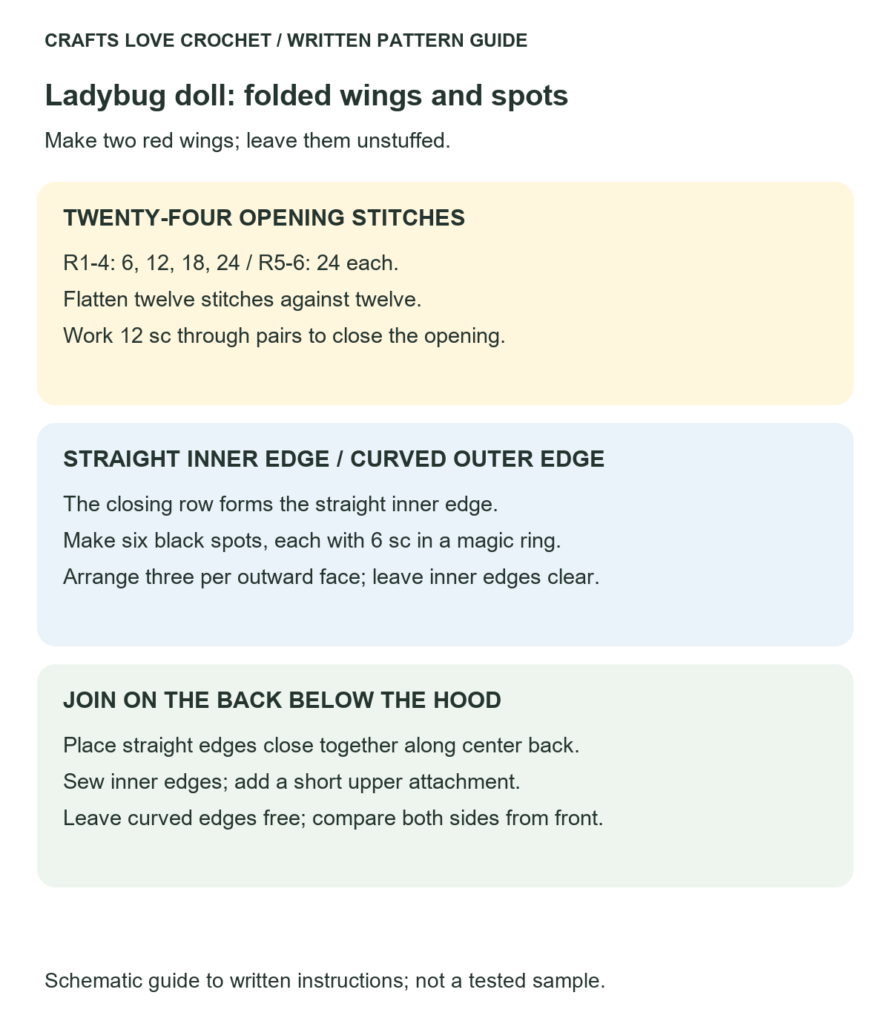
Open this guide at a larger size.
Optional Red Bow
With red, ch 10.
Row 1: Sc in the second ch from the hook and in each remaining ch. (9 sc)
Fasten off with a long tail.
Pinch the strip at its center and wrap the tail around that middle section several times. Secure the wraps on the back.
Leave enough yarn to sew the bow to the hood.
Visual Guide: Open Neck Join and Hood Placement
Join the open body neck around the underside of the closed head, then fit the hood around the back of the head before securing the antennae.

Open this guide at a larger size.
Assemble the Doll
Join the Head and Body
Place the body’s open rim against the underside of the head, centered around the gathered closure.
Sew the twelve body stitches to a corresponding circle of fabric around Round 16 of the head. The final head closure sits inside this circle.
Work around the entire neck opening rather than attaching the head at only a few points. Add any final body stuffing before completing the seam.
Check that the face points straight forward and the head does not tilt unintentionally.
Position the Legs
Place both legs at the lower front of the body, with their rounded ends pointing forward.
Sew their closed edges to the body around the lower side rounds. Compare their height and spacing before securing the tails.
This arrangement creates a seated pose. It is not intended to make the doll stand unsupported.
Sew on the Hood
Reposition the hood around the face. Sew its rim to the head with small brown stitches, keeping the sewing yarn out of the visible beige face where possible.
Do not pull the rim tightly enough to distort the eyes or cheeks.
Attach the antenna bases symmetrically near the top of the hood. Sew around each four-stitch base, catching the head fabric beneath the hood as well.
Attach the Wings
Place the spotted sides outward.
Position the straight edges close together along the center of the back, with the curved edges spreading to either side. Keep the upper ends below the hood.
Sew the inner edges to the back of the body. Add a short attachment across the upper portion of each wing to limit rotation.
Leave the curved outer edges free. Check the front view to make sure the wings appear balanced on both sides.
Sew the optional bow to one side of the hood, catching its center wraps securely.
Practical Finishing Checks
Inspect the neck seam before covering the back. It is easier to reinforce this join before the wings are attached.
Keep filling away from closing edges. The legs need a little fullness at the ends, but stuffing at their upper seams makes them harder to flatten and sew.
Check the hood with the face completed. A hood that seems suitable on an empty head may sit differently after stuffing.
Place all six spots before sewing. Adjusting their arrangement is easier while they are still loose.
Keep the antennae soft. Their shape comes from the narrow crochet tube and rounded tip; they do not require wire.
For the ladybug doll amigurumi pattern, the final assembly determines much of the character. Inspect it from the front, back, and sides before trimming the remaining tails.
Frequently Asked Questions
Is this ladybug doll amigurumi pattern suitable for beginners?
The stitch sequences are approachable for crocheters who know basic amigurumi. The hood fitting, small antennae, and separate-part assembly make it better suited to a confident beginner or intermediate maker.
Why is the hood worked to thirty-six stitches?
The head reaches thirty-six stitches at its widest section, so the revised hood uses that count as a fitting starting point. Yarn thickness, stuffing, and tension still affect the actual fit.
Should the wings be stuffed?
No. They are folded and closed without filling. Stuffing would make them bulkier and change how they sit against the back.
Can I use black instead of brown?
Yes. Using black for the body, hood, legs, and antennae creates a stronger contrast with the red wings. Choose yarn of comparable thickness to preserve the proportions.
Are embroidered eyes enough to make the doll suitable for a young child?
Eye style is only one part of the finished item. Seams, detachable pieces, materials, and the intended age also matter. Do not assume that changing the eyes alone establishes suitability.
Another Character for Your Crochet Collection
If you enjoy assembling rounded character shapes, explore the crochet little alien amigurumi pattern for a different face and silhouette.
For an accessory project, the cat keychain strap crochet pattern combines a character with a strap-style construction.
A final photo from the back is useful for this doll: it shows the wing spacing and spot arrangement that a front view can hide. Keep that photo with your yarn and hook notes if you plan to make another.
Would you choose the brown costume or a classic black-and-red combination? Share your version and finished measurements in the comments.