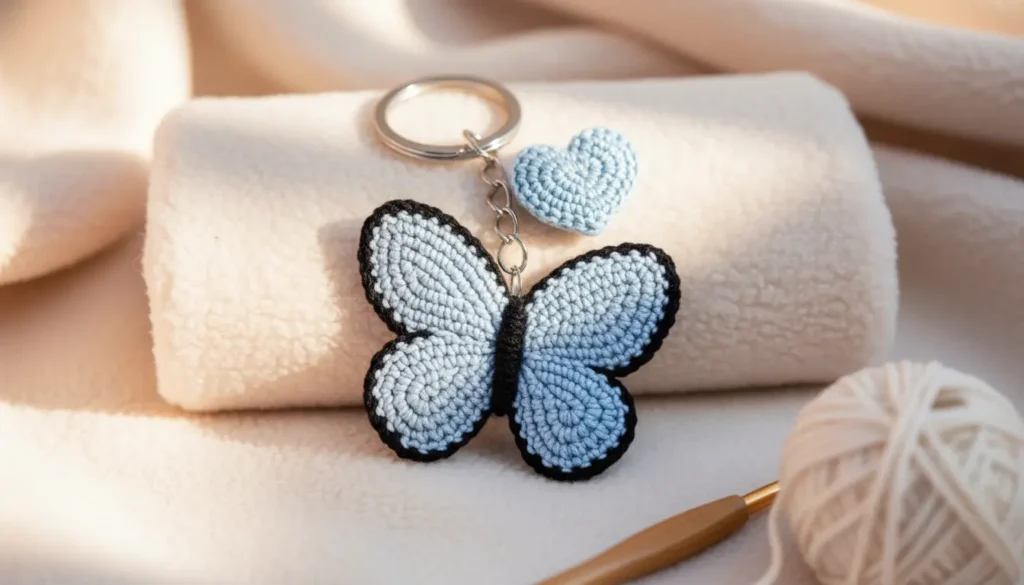
This crochet butterfly keychain pattern uses four rounded wings outlined in a contrasting color. Two larger wings sit above two smaller ones, with a black crochet panel joining them at the center.
The butterfly is made without stuffing. Each wing is a single-layer piece, so the finished shape comes from the difference in wing sizes, their arrangement, and the central seam.
Light blue and black create a clear contrast, but you can choose another wing color while keeping the same yarn thickness throughout. Arrange all four pieces before sewing so you can compare the two sides.
Materials for the Crochet Butterfly Keychain Pattern
- Sport- or DK-weight yarn in light blue for the wings.
- Matching-weight black yarn for the borders, body, and attachment.
- A 2.5 mm crochet hook as a starting option.
- A yarn needle.
- Stitch markers.
- A keyring with a short attachment chain.
- Scissors.
Use the same yarn weight for the blue and black sections. A much thicker border yarn can change the shape of the wings.
Choose a hook that produces a fabric you can work comfortably. Finished dimensions depend on yarn thickness and tension; measure the assembled butterfly before choosing packaging or planning several matching pieces.
No fiberfill is required.
Construction Notes
This crochet butterfly keychain pattern contains:
- Two large upper wings.
- Two smaller lower wings.
- One rectangular central body.
- A sewn attachment to the keychain hardware.
Work the wing rounds continuously, without joining or adding beginning chains, until instructed to change color.
Mark the first stitch of each round.
The body is worked in turned rows. Its beginning ch-1 does not count as a stitch.
The wings are rounded disks. There are no corner stitches requiring additional increases.
Abbreviations — US Terms
- MR: magic ring.
- ch: chain.
- sc: single crochet.
- inc: work 2 sc into one stitch.
- sl st: slip stitch.
- st / sts: stitch / stitches.
- FO: fasten off.
A sequence such as “(3 sc, inc) six times” means working one sc into each of the next three stitches, then two sc into the following stitch, and repeating that sequence six times.
For terminology help, consult the Craft Yarn Council’s crochet abbreviation reference, which includes a comparison of US and UK terms.
Crochet Butterfly Keychain Pattern: Upper Wings
Make two with light blue yarn.
Blue Section
- Round 1: Work 6 sc into a MR. (6)
- Round 2: Inc in every stitch. (12)
- Round 3: (1 sc, inc) six times. (18)
- Round 4: (2 sc, inc) six times. (24)
- Round 5: (3 sc, inc) six times. (30)
After Round 5, sl st into the next stitch and fasten off.
The finishing slip stitch does not add to the count. Keep the 30 actual sc identifiable for the border.
Black Border
Join black yarn in any actual sc from Round 5.
Ch 1. Starting in that same stitch, repeat the following sequence six times:
- Work 1 sc into each of the next four stitches.
- Work 2 sc into the following stitch.
Join with a sl st to the first sc.
Border count: 36 sc.
The beginning ch-1 and joining slip stitch do not count as stitches.
Fasten off and weave in the ends. Repeat for the second upper wing.
Lower Wings
Make two with light blue yarn.
Blue Section
- Round 1: Work 6 sc into a MR. (6)
- Round 2: Inc in every stitch. (12)
- Round 3: (1 sc, inc) six times. (18)
- Round 4: (2 sc, inc) six times. (24)
Sl st into the next stitch and fasten off.
Do not count this finishing slip stitch as an additional stitch.
Black Border
Join black yarn in any actual sc from Round 4.
Ch 1. Starting in that same stitch, repeat the following sequence six times:
- Work 1 sc into each of the next three stitches.
- Work 2 sc into the following stitch.
Join with a sl st to the first sc.
Border count: 30 sc.
Fasten off and weave in the ends. Repeat for the second lower wing.
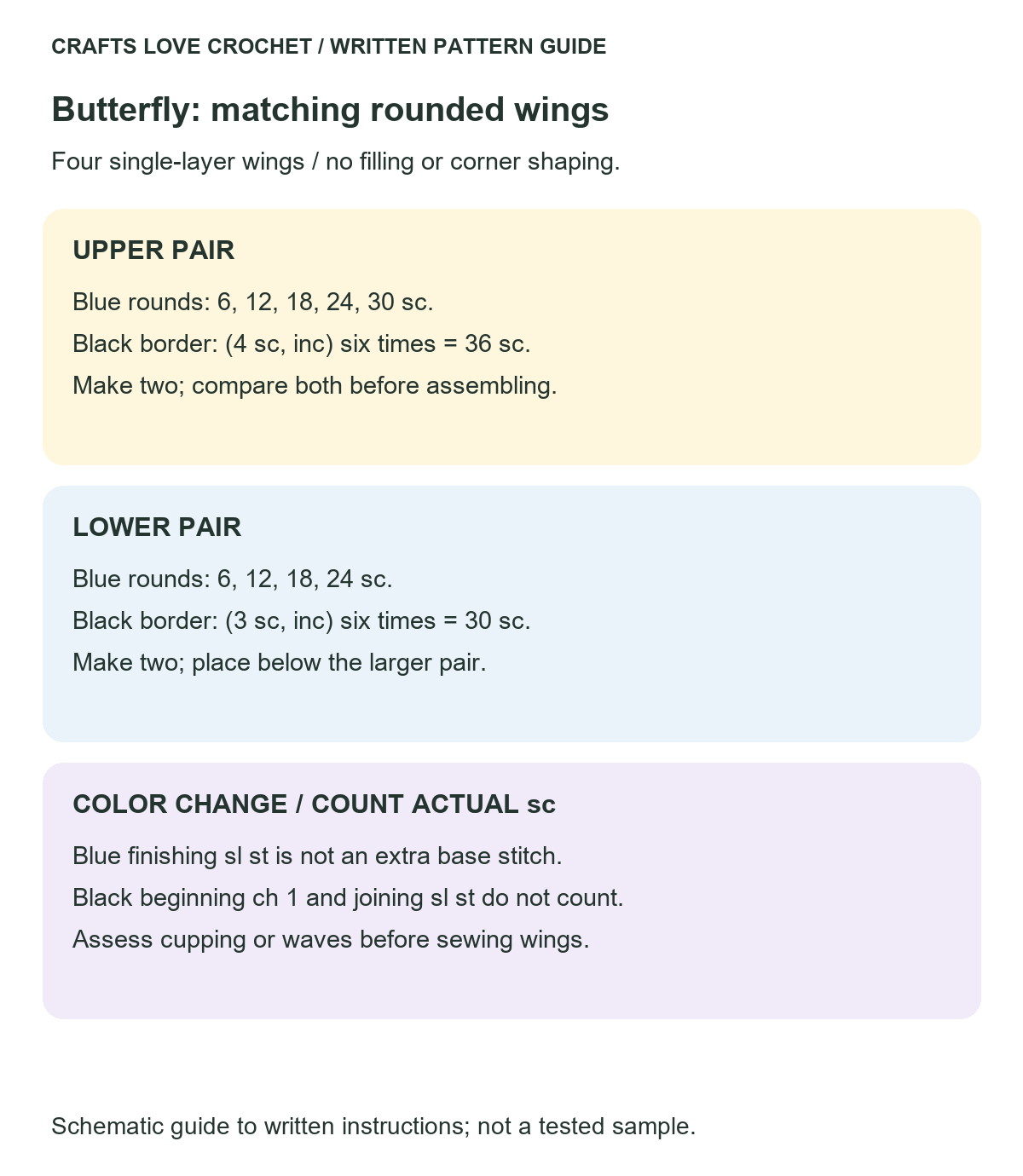
Visual Guide: Upper and Lower Wing Counts
Compare the upper and lower wing counts before sewing the four pieces together.
Open this guide at a larger size.
Check the Four Wings
Lay the pieces on a flat surface without stretching them.
The two upper wings should be similar in size to each other, as should the two lower wings.
Check the counts if one piece differs noticeably:
- Upper wings: 30 blue stitches followed by a 36-stitch black border.
- Lower wings: 24 blue stitches followed by a 30-stitch black border.
If the counts match but the fabric still cups or waves, assess the tension and yarn combination before assembling. Do not rely on forceful blocking to correct a construction problem.
Central Body
Use black yarn.
Foundation
Ch 6.
Row 1
Starting in the second chain from the hook, sc in each chain across.
Count: 5 sc.
Rows 2–5
Ch 1, turn.
Sc in each of the five stitches across.
Count: 5 sc per row.
Fasten off with a long sewing tail.
The finished panel has five rows of five stitches. It will lie over the center of the wings rather than being stuffed or folded into a tube.
Assemble the Crochet Butterfly Keychain Pattern
Arrange the Wings
Place all four wings with their right sides facing upward.
Position the two large wings at the upper left and upper right. Place the smaller wings below them.
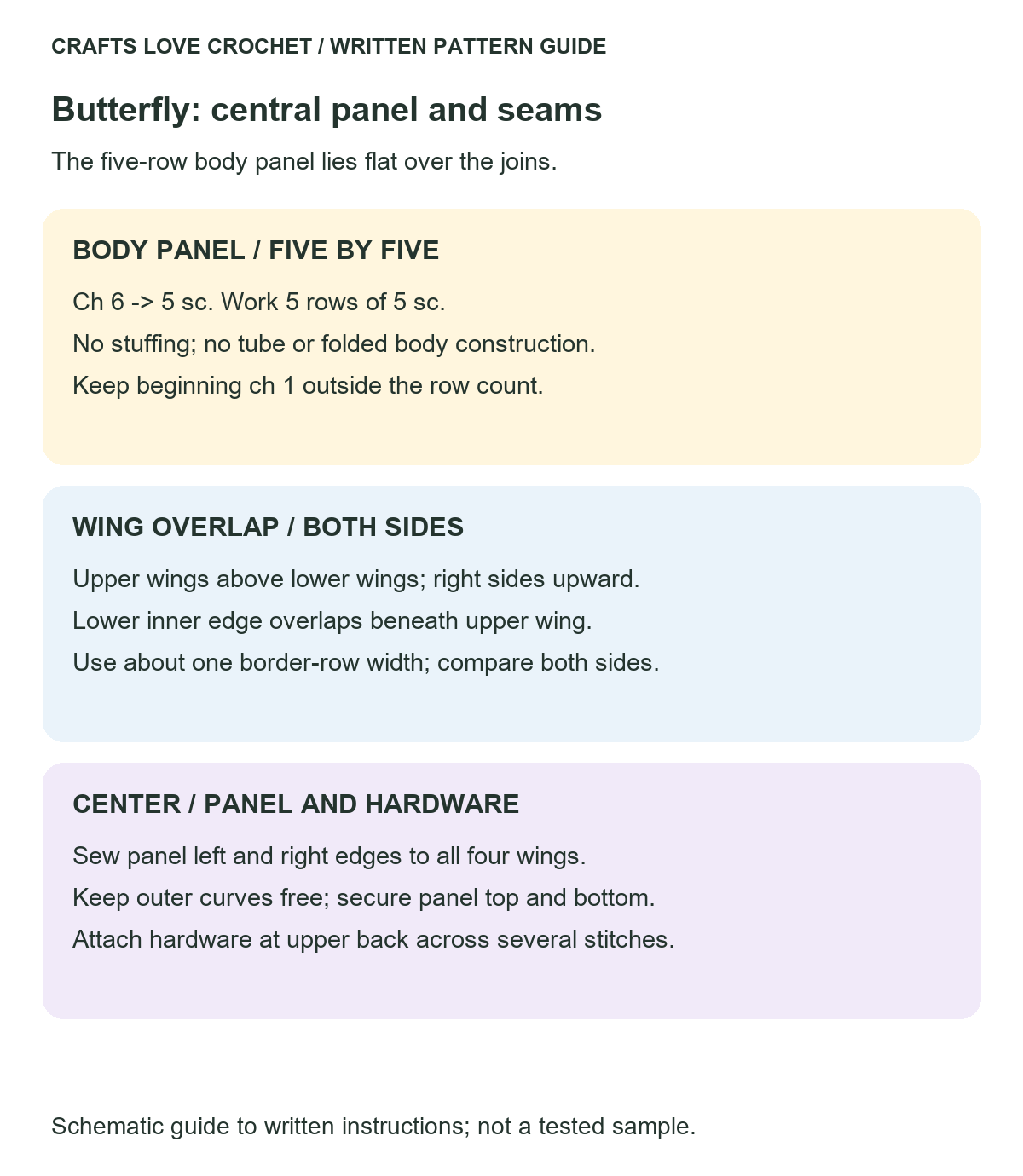
On each side, overlap the inner portion of the lower wing beneath the upper wing by approximately one border-row width.
Bring the inner edges of the left and right pairs toward the center. Leave the outer curves spread apart so all four wing shapes remain visible.
Place the body panel over the central meeting area.
Before sewing, check that the panel covers the inner edges of all four wings without requiring them to be pulled sharply inward.
Join Each Wing Pair
Temporarily remove the body panel.
Using black yarn, sew through several stitches in the overlapping area between the upper and lower wing on one side.
Repeat on the other side, matching the overlap and angle.
Keep the sewing close to the central area. Do not sew the full outer wing edges together.
Attach the Body
Replace the black body panel over the center.
Sew along its left edge, catching the inner portions of both left wings. Then sew along its right edge, catching both right wings.
Secure the top and bottom of the panel where they meet the underlying crochet.
Check from the back that every wing is attached to the central structure. Add discreet stitches where necessary, spreading the attachment over several stitches rather than relying on one point.
Secure and weave in the ends.
Visual Guide: Four Wing Assembly and Hardware
Use this assembly map to position the wings and secure the hardware through several stitches.
Open this guide at a larger size.
Attach the Keychain Hardware
Position the terminal link of the keychain’s short chain against the upper back of the central body.
Using a separate length of black yarn, make several sewing passes through that link and through multiple stitches across the top of the body panel. Where possible, catch the underlying wing fabric as well.
Distribute the attachment across the central structure. Avoid suspending the butterfly from one wing-edge stitch.
Secure the sewing yarn and weave it back through several stitches.
Check that the hardware has no sharp or rough edge that catches the yarn. A gentle pull can reveal a loose seam, but it does not establish a load rating.
Use the butterfly as a decorative keychain charm rather than a carrying strap.
Practical Tips
Make Matching Pairs Before Assembly
Complete both upper wings, compare them, and then complete the lower pair. Differences are easier to spot before the pieces are sewn together.
Keep the Color Change Out of the Count
The slip stitch used to finish a blue section is not an additional base stitch. Work the black border only into the actual single crochet stitches.
Check Both Sides Before Tightening the Seams
View the butterfly from the front and back. A seam that looks balanced from one side may pull a wing inward on the other.
Let the Body Cover the Central Joins
Keep the wing-pair seams close to the center so the body panel can conceal them. The exposed outer curves should remain free.
Inspect the Attachment Periodically
The yarn touching the hardware receives repeated movement. Check for loosening, fraying, or distortion and repair the attachment before continued use.
Color Variations and Care
Try lilac, yellow, pink, or cream wings with a contrasting border. Keep the yarn thickness consistent when changing colors.
Follow the yarn manufacturer’s washing and drying instructions. Remove the hardware before washing when practical, and arrange the wings gently while drying.
Avoid direct heat or steam unless the yarn’s care guidance permits it.
More Small Crochet Projects
For another character-style accessory, explore the Crochet Cloud Keychain Pattern, which uses a cloud motif and facial details.
If you enjoy animal shapes, visit the Crochet Goldfish Keychain Pattern for a different outline built around a fish body, fins, and tail.
Frequently Asked Questions
Does This Crochet Butterfly Keychain Pattern Need Stuffing?
No. This version uses four single-layer wings and a flat central body. There are no enclosed wing pockets to hold filling.
Why Are the Upper Wings Larger?
The upper blue sections finish at 30 stitches before the border, while the lower blue sections finish at 24. Their black borders finish at 36 and 30 stitches respectively.
Are There Increases at the Wing Corners?
No. These wings are circular and have no designated corners. The border increases are distributed evenly according to the written repeat.
Can I Use Thicker Yarn?
Thicker yarn and a suitable hook will change the size and weight. Make one upper and one lower wing first, then check their proportions and how the fabric behaves.
How Do I Keep the Butterfly Symmetrical?
Compare matching wings before assembly, use the same overlap on both sides, and position the body panel before sewing. Adjust temporary placements before securing the seams.
Share Your Butterfly
Record your yarn, hook, and finished wingspan when making this crochet butterfly keychain pattern. Note any adjustments to the wing overlap or body placement so you can reproduce the arrangement.
Share your color combination and construction observations in the comments. If a step needs clarification, include the wing section or assembly stage.