A small flower can finish a project without becoming its main feature. Sew one beside a pouch zipper, place a few along a fabric border, or use a contrasting color to brighten a plain crochet accessory.
This crochet flower pattern has three rounds: a single-crochet center, five chain spaces, and five petals. Each petal combines double crochet stitches with a taller treble crochet in the middle.
The chain-space round determines the number of petals. Count those five spaces before beginning the final round, and the rest of the flower becomes much easier to follow.

Choose Your Yarn and Hook
You will need:
- Worsted-weight yarn in one color, or two colors for a contrasting center.
- A 3–4 mm crochet hook suited to your yarn.
- Yarn needle.
- Scissors.
Smooth yarn makes the small stitches easier to identify. Cotton can give clear stitch definition, while a softer yarn will change how the petals drape.
Skill level: Confident beginner. The pattern uses a magic ring, single crochet, double crochet, treble crochet, and slip stitches.
Finished diameter depends on yarn and tension. Make one flower and compare it with its intended placement before making several.
For a smaller flower, use finer yarn with an appropriate hook. Keep the stitch instructions unchanged.
Stitch Guide
This pattern uses US crochet terminology.
| Abbreviation | Meaning |
|---|---|
| MR | magic ring |
| ch | chain |
| sl st | slip stitch |
| sc | single crochet |
| dc | double crochet |
| tr | treble crochet |
| st / sts | stitch / stitches |
| sp | space |
Treble crochet: Yarn over twice, insert the hook into the indicated space, yarn over and draw up a loop. Yarn over and pull through two loops three times.
The Craft Yarn Council’s crochet abbreviation guide provides standard abbreviations and US–UK comparisons.
Beginning chains and joining slip stitches do not count as single crochet stitches. The chain spaces in Round 2 are counted separately.
Crochet Flower Pattern: Three Rounds
Work in joined rounds without turning.
Round 1 — Center
Make a magic ring.
Ch 1 and work 10 sc into the ring. Pull the ring closed and join with a sl st to the first sc.
Count: 10 sc.
Keep the center yarn attached if making a single-color flower.
For a contrasting center, fasten off and attach the petal color with a sl st in any stitch before starting Round 2.
Round 2 — Five Petal Spaces
Ch 1. Beginning in the same stitch as the join, repeat the following sequence five times:
Sc in next st, ch 2, skip next st.
Join with a sl st to the first sc.
Count: 5 sc and 5 ch-2 spaces.
Each repeat uses two stitches from Round 1: one receives a single crochet, and the other is skipped beneath the chain space.
Check that you have five openings around the center before continuing.
Visual Guide: Five Foundation Spaces
Keep five chain spaces available for the five petals.
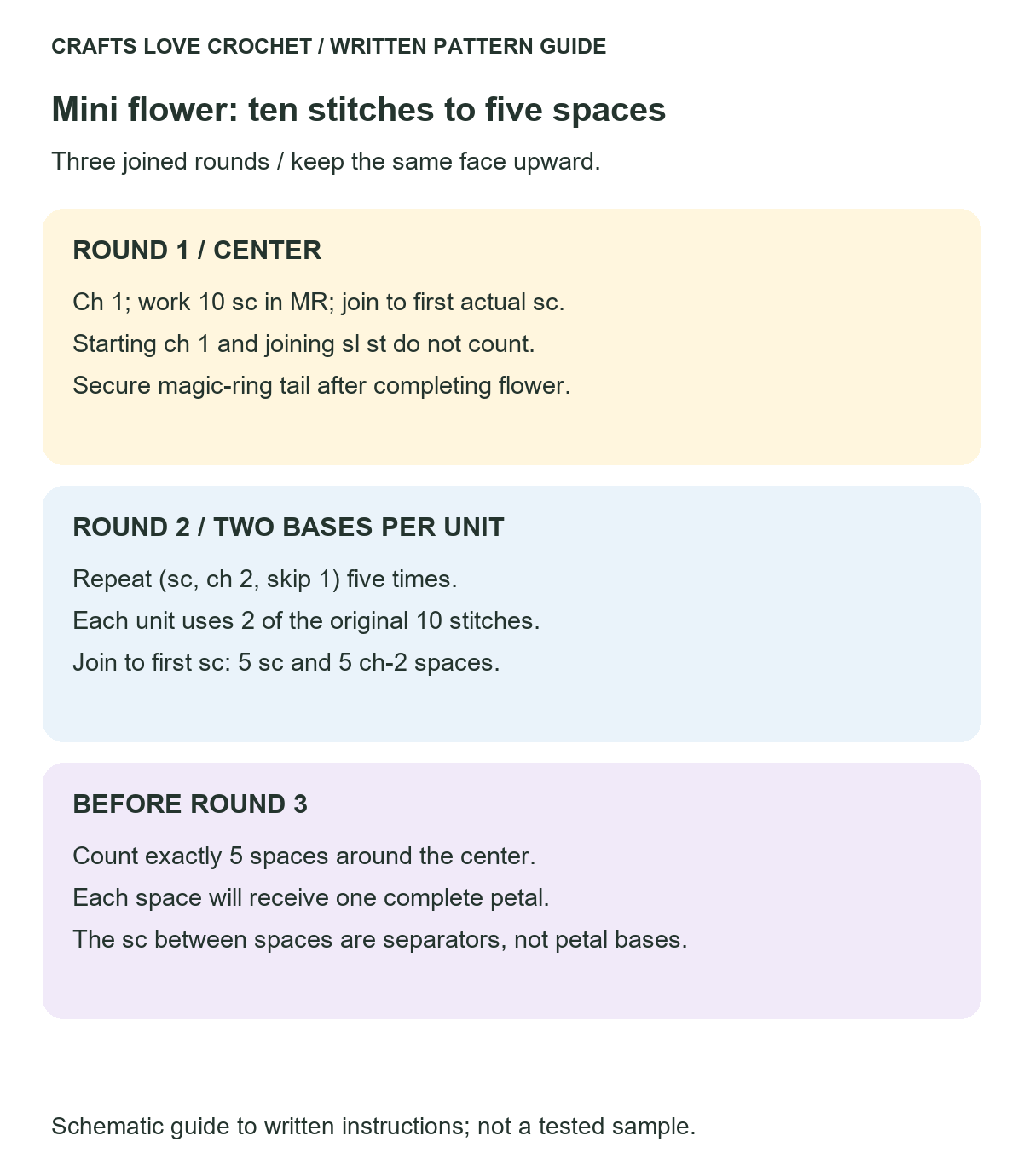
Open this guide at a larger size.
Round 3 — Five Petals
Sl st into the first ch-2 space.
Work the following complete sequence into that space:
Ch 2, 3 dc, 1 tr, 3 dc, ch 2, sl st into the same space.
That completes the first petal.
Sl st into the next sc from Round 2, then sl st into the next ch-2 space. Work the same petal sequence there.
Continue until all five chain spaces contain one petal.
After completing the fifth petal, sl st into the first sc of Round 2 to finish the circuit. Fasten off.
Count: 5 petals. Each petal contains 6 dc and 1 tr, framed by two ch-2 sections.
Do not work petals into the single crochet stitches between the spaces. Those stitches separate the petals.
Visual Guide: One Petal in Each Space
Work the full petal sequence inside one foundation space before moving to the next.
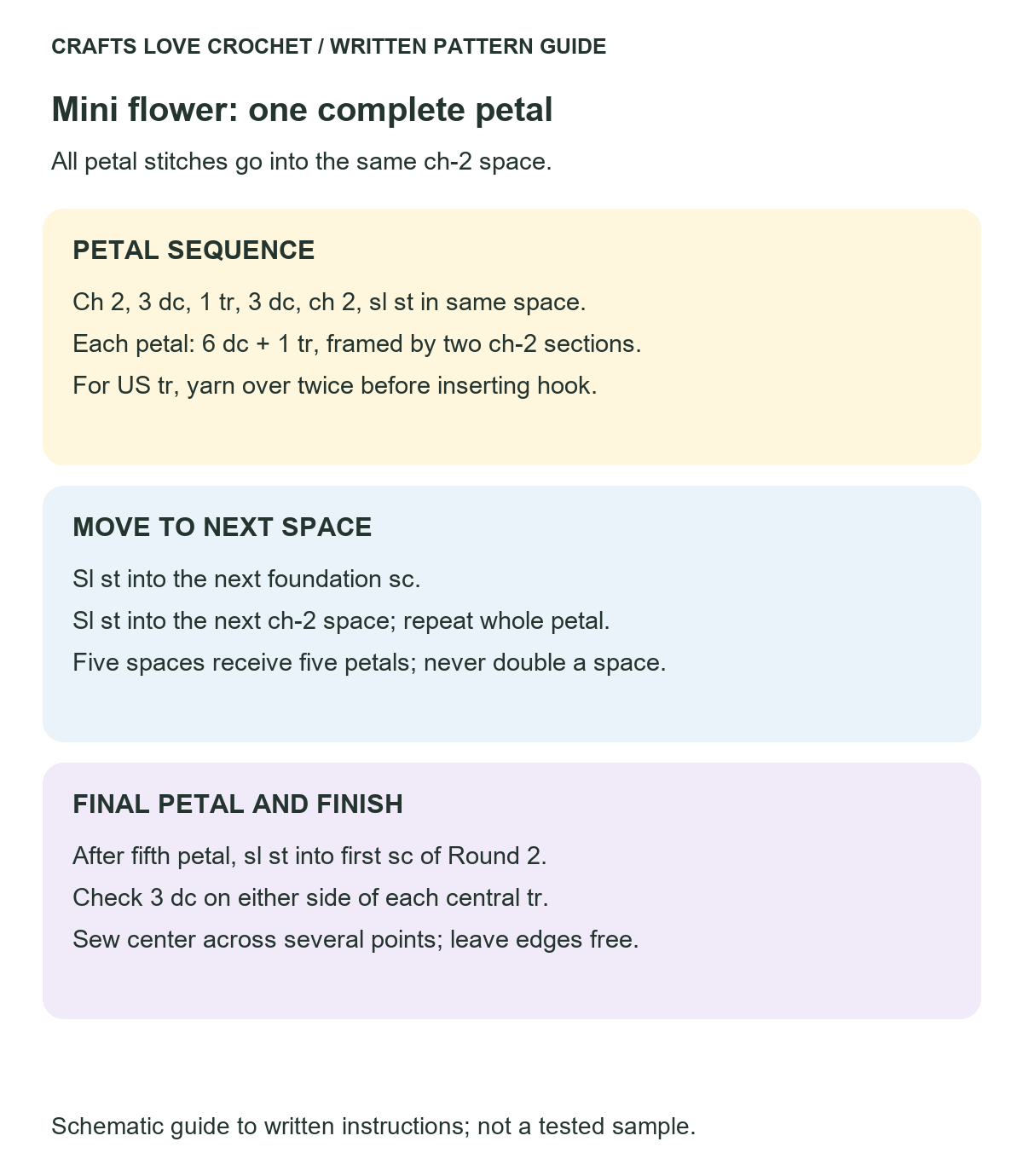
Open this guide at a larger size.
Check the Flower Before Weaving In
Place the flower on a flat surface and gently separate the petals.
Check that:
- There are five petals.
- Every petal has three dc before its center tr and three dc after it.
- Each petal begins and ends in the same chain space.
- No chain space contains two petals.
The petals may have some dimension. Pronounced twisting or uneven crowding should be checked against the stitch sequence before attempting to stretch the flower into shape.
Secure the Center
Thread the magic-ring tail onto a yarn needle and weave it through the backs of several center stitches. Change direction before trimming.
Closing the ring does not replace securing its tail. A loose tail can allow the center to reopen with handling.
Finish the Petal Yarn
Weave the ending tail through stitches on the back, keeping it away from the visible petal tips.
If you plan to sew the flower onto another project, you can leave a longer tail for attachment instead of trimming it immediately.
Sew the Flower onto Fabric or Crochet
Try the placement before stitching. A flower near a pocket or zipper should not block the opening or catch in the fastening.
Use matching yarn or suitable sewing thread to attach the center first. Spread the attachment stitches around the center rather than using only one point.
For a decorative piece, leave the petal edges free. For an item that will be handled or washed, add discreet stitches near the outer sections of the petals to help prevent snagging.
Avoid pulling the sewing yarn tightly enough to pucker the background.
For a larger botanical arrangement, the daisy flower crochet appliqué pattern includes a separate stem and leaves. You can use similar colors to make the two motifs feel coordinated.
Practical Tips for Consistent Petals
Keep the chain spaces comfortable. Very tight ch-2 spaces make the final round harder to work. Form them with an even tension rather than tightening each chain against the hook.
Make the treble crochet deliberately. It uses two initial yarn overs. Accidentally working a double crochet in its place changes the middle of the petal.
Keep the slip stitches relaxed. Tight joins between petals can draw the spaces together and distort the center.
Compare one complete flower before making a batch. Small differences in yarn thickness can affect both the size and the amount of curl.
Block only if your yarn allows it. Gentle damp shaping may smooth minor irregularities. Avoid assuming that all fibers tolerate steam.
The most useful checkpoint in this crochet flower pattern is still Round 2: five spaces give you five clearly defined places to work.
Color Variations
A single color emphasizes the outline. A contrasting center makes the construction more visible, especially when the center and petals differ in brightness.
Try cream with a yellow center, lavender with a pale pink center, or a deeper flower color against a neutral background.
Keep both yarns similar in thickness. A heavy petal yarn on a much finer center can change the proportions and make the stitches crowded.
If you want another small decoration with a different silhouette, the crochet bunny appliqué pattern pairs a simple body with upright ears and a small tail.
Frequently Asked Questions
Is this crochet flower pattern suitable for beginners?
Yes, for crocheters comfortable with the basic stitches. If treble crochet is new to you, practice a few stitches before beginning the petal round.
Why does my flower have more than five petals?
Check Round 2. It should contain five chain spaces, not ten. The repeat includes skipping one stitch after each ch-2 section.
Can I substitute puff stitches for the petals?
Puff stitches create a different structure and require their own instructions. This version uses the written double- and treble-crochet sequence throughout.
Does the flower need stuffing?
No. It is an unstuffed motif. Its dimension comes from the petal stitches and the yarn itself.
Can I make the flower larger?
Using thicker yarn with a suitable hook changes the scale while keeping the five-petal structure. Check the finished flower against your project before attaching it.
Find a Place for Your Flower
Lay the finished flower against a few different backgrounds before sewing it down. The same color can look subtle on one fabric and stand out strongly on another.
If you make several, record the yarn and hook used for the first one so the sizes remain consistent. Arrange the whole group before attaching individual flowers.
Share your color combination and where you used the motif—sometimes a small finishing detail gives another crocheter an idea for a project already on their hook.