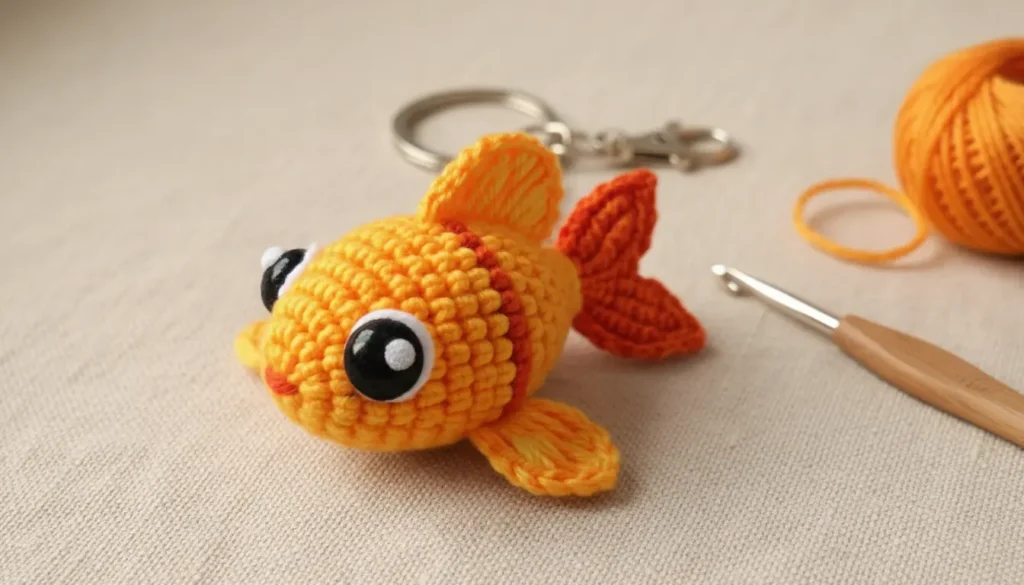
A rounded orange body and a split tail give this little fish its character. Yellow fins add contrast, while embroidered eyes keep the face simple.
This crochet goldfish keychain pattern uses a stuffed body with separate, unstuffed fins and tail pieces. The body is worked from the front of the fish toward the tail, and a short crocheted loop provides the attachment point for the keyring.
The finishing stage determines how the fish hangs. Arrange the tail and fins first, then check the position of the loop before securing its final stitches.
Gather Your Materials
- Worsted-weight cotton yarn in orange and yellow.
- Black embroidery yarn or thread for the eyes.
- A 2.5 mm crochet hook, or a size suited to your yarn.
- Polyester fiberfill.
- Yarn needle.
- Stitch marker.
- Scissors.
- Split keyring, with an optional clasp or short chain.
Choose a hook that produces close stitches without making the fabric difficult to work. Worsted yarns vary in thickness, so a 2.5 mm hook will not suit every brand.
Skill level: Confident beginner. The main techniques are single crochet increases and decreases, basic fin stitches, and sewing small parts.
Finished dimensions depend on the yarn and hook combination. Complete one fish before choosing hardware for a matching set.
Stitch Terms
This pattern uses US crochet terminology.
| Abbreviation | Meaning |
|---|---|
| MR | magic ring |
| ch | chain |
| sl st | slip stitch |
| sc | single crochet |
| hdc | half double crochet |
| dc | double crochet |
| inc | 2 sc in the same stitch |
| dec | single crochet decrease |
| st / sts | stitch / stitches |
For an invisible decrease, insert the hook beneath the front loops of the next two stitches, draw yarn through those loops, then complete the single crochet.
The Craft Yarn Council’s crochet abbreviation guide provides a reference for standard stitch names and US–UK terminology.
Work the body and tail pieces in continuous rounds. Do not join or turn at the end of a round. Move the stitch marker to the first stitch of each new round.
Crochet Goldfish Keychain Pattern: The Body
With orange yarn:
| Round | Instructions | Count |
|---|---|---|
| 1 | 6 sc in MR | 6 |
| 2 | Inc in each st | 12 |
| 3 | (Sc, inc) 6 times | 18 |
| 4 | (Sc in next 2 sts, inc) 6 times | 24 |
| 5–9 | Sc in each st | 24 |
The magic-ring end is the front of the fish. The opening will become the rear.
Mark the Face
Choose the upper side of the fish and mark it temporarily.
Place two eye markers between Rounds 5 and 6, approximately six stitches apart across the upper front portion of the body. Keep them balanced on either side of the chosen top line.
Use a few small black stitches for each eye. Avoid pulling tightly enough to sink the embroidery into the fabric.
Secure the embroidery ends inside while the opening is accessible.
Shape and Close the Rear
Round 10: (Sc in next 2 sts, dec) 6 times. (18 sts)
Round 11: (Sc, dec) 6 times. (12 sts)
Add fiberfill in small amounts. Shape the body evenly, keeping the stitches close enough to conceal the filling.
Round 12: Dec 6 times. (6 sts)
Fasten off with a tail. Thread it through the front loops of the final six stitches and draw the opening closed.
Secure the tail and hide the end inside the body.
Make the Two Tail Lobes
With orange yarn:
- Round 1: 6 sc in MR. (6)
- Round 2: (Sc, inc) 3 times. (9)
- Round 3: Sc in each st. (9)
- Round 4: (Sc in next 2 sts, inc) 3 times. (12)
- Round 5: Sc in each st. (12)
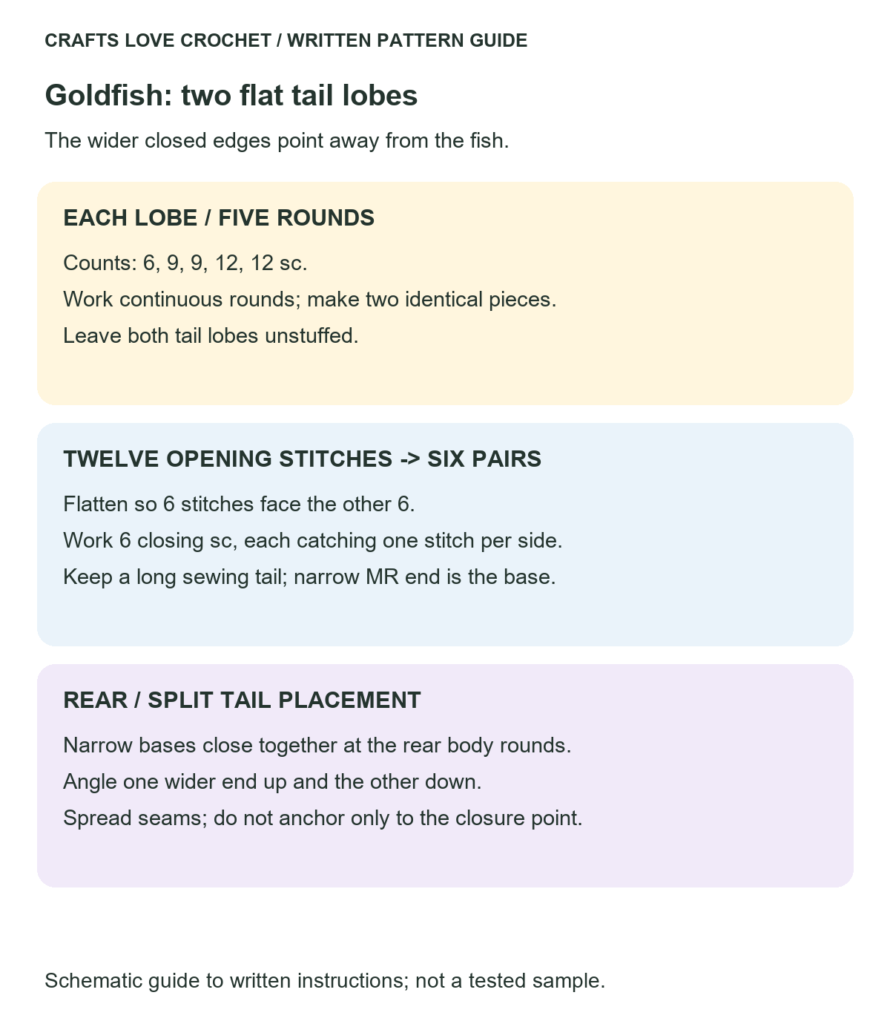
Do not stuff.
Flatten the opening so six stitches face six stitches. Work 6 sc through both layers, catching one stitch from each side for every closing stitch.
Fasten off with a long sewing tail.
Make a second identical piece.
The narrow magic-ring end of each piece will attach to the fish. The wider, closed edge points away from the body.
Visual Guide: Flat Tail Lobes and Rear Placement
Close each unstuffed twelve-stitch lobe in six opposing pairs and attach its narrow starting end to the rear body fabric.
Open this guide at a larger size.
Yellow Fins
Top Fin
With yellow, ch 6.
Starting in the second ch from the hook, work:
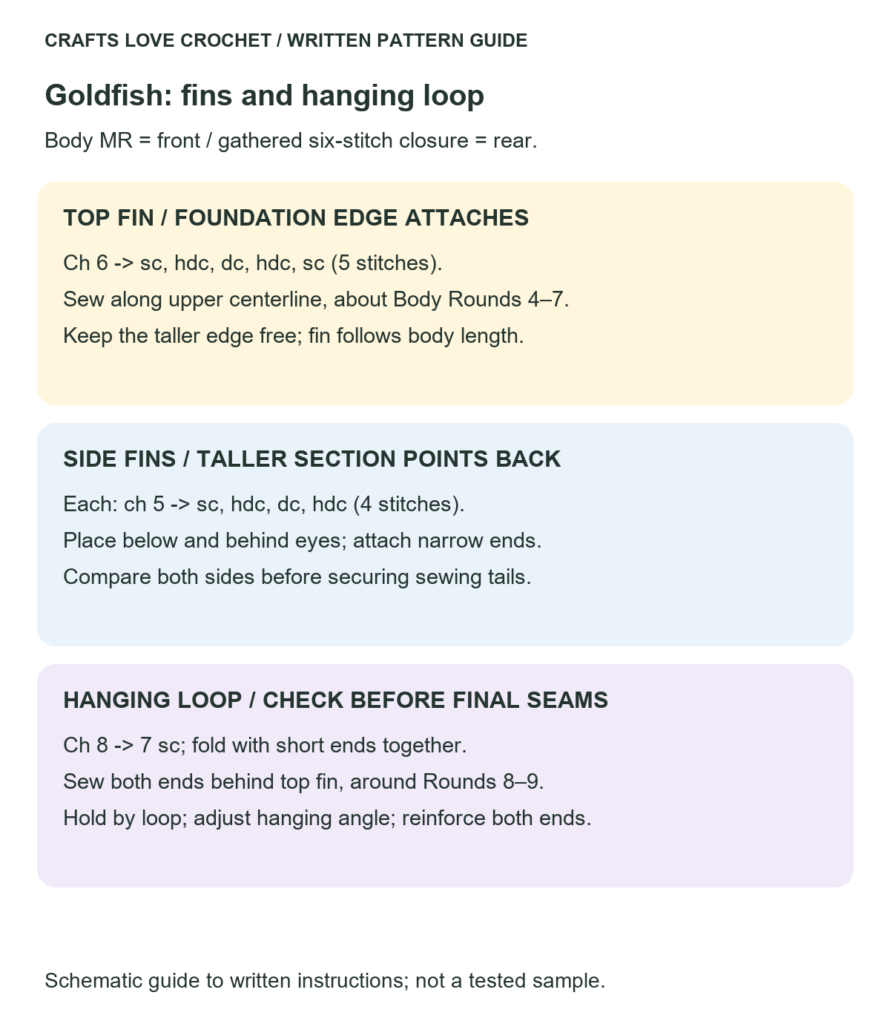
Sc, hdc, dc, hdc, sc, one stitch in each chain. (5 sts)
Fasten off with a sewing tail.
The foundation-chain edge is the attachment edge. The taller center stitch creates the raised outline.
Side Fins — Make Two
With yellow, ch 5.
Starting in the second ch from the hook, work:
Sc, hdc, dc, hdc, one stitch in each chain. (4 sts)
Fasten off with a sewing tail.
Leave these pieces unstuffed.
Assemble the Fish Before Adding Hardware
Place the body on its side with the face at one end and the gathered rear closure at the other.
Position the Tail
Arrange the two tail pieces at the rear, with their narrow ends close together and their wider ends spreading apart.
For a vertical split tail, angle one lobe upward and the other downward. Check the outline from the side before sewing.
Sew each narrow end to the rear body fabric around the closing rounds. Spread the attachment across several stitches rather than anchoring both lobes only to the final closure point.
Add a small stitch between the two tail bases if needed to hold their relative positions.
Attach the Top Fin
Place the top fin along the upper centerline of the body, approximately across Rounds 4–7.
Sew its foundation edge to the body with small yellow stitches. Keep the taller edge free.
Check that the fin follows the body’s length rather than crossing it sideways.
Attach the Side Fins
Position one fin on each side, slightly below and behind the eyes.
Attach the narrow beginning end of each fin, with the taller section extending backward toward the tail. Add a second small attachment if a fin rotates.
Compare the positions from the front and above before securing the tails.
Optional Mouth
Use a short piece of contrasting orange or yellow yarn to embroider a small mouth near the front magic ring.
A single short stitch or shallow curve is enough. Keep the embroidery small so it does not distort the front of the fish.
Make and Attach the Hanging Loop
With orange, ch 8.
Starting in the second ch from the hook, sc in each chain across. (7 sc)
Fasten off, leaving sewing tails.
Fold the strip into a loop with its short ends together.
Position the ends on the upper body just behind the top fin, around Rounds 8–9. Sew each end over a small area of body fabric, using multiple stitches in different directions.
Catch actual crochet stitches rather than sewing only through the stuffing. Keep the folded portion free for the keyring.
Before securing the final tails, hold the fish by the loop and check how it hangs. Move the attachment slightly if the head or tail drops more than you want.
Once satisfied, reinforce both ends and weave in the tails through several stitches, changing direction.
Thread the split keyring through the loop. If using a chain or clasp, ensure its connector is fully closed.
Gently check the attachment for slipping or excessive stretching. A crocheted loop is a wear point, so inspect it occasionally during use.
Visual Guide: Fin Direction and Hanging Loop
Compare the fin directions, then check the fish hanging from its loop before securing the final attachment stitches.
Open this guide at a larger size.
Practical Finishing Notes
Keep the tail unstuffed. Its folded construction provides thickness without making the rear of the fish unnecessarily heavy.
Check the body before closing. Uneven filling is easier to redistribute while twelve stitches remain open.
Match the side-fin direction. Both taller ends should point toward the tail.
Avoid one-point attachments. Tail bases, fins, and the hanging loop stay better aligned when their sewing stitches are spread over a small area.
Use the hanging check as part of assembly. A balanced position on the table does not necessarily produce the same angle when suspended.
These details are particularly useful when repeating the crochet goldfish keychain pattern in different yarns. A heavier tail or different hardware can change the hanging angle.
Frequently Asked Questions
Is this crochet goldfish keychain pattern suitable for beginners?
It is suitable if you know basic amigurumi increases and decreases. The fins introduce half double and double crochet, while the tail requires working through two layers to close an opening.
Where does the fish’s face go?
The magic-ring end of the body is the front. The eyes sit farther back between Rounds 5 and 6, and the tail attaches at the gathered closing end.
Do the fins or tail need stuffing?
No. Only the body is stuffed. The tail pieces are flattened and closed, while the fins are single layers.
Can I use acrylic yarn?
Yes, with a hook that produces suitable fabric. The body firmness and fin drape may differ from cotton, so check the finished assembly and hanging position.
How should I clean the keychain?
Follow the yarn’s care instructions and remove hardware where possible. Spot cleaning may be enough. Allow the body and filling to dry completely before reattaching the metal parts.
More Small Crochet Accessories
For another project built from separate decorative pieces, explore the crochet butterfly keychain pattern. Its contrasting wing sections offer a different way to combine colors.
The crochet sunflower keychain pattern is another option if you want a floral companion for your fish charm.
Try an orange body with pale yellow fins first, then change just one color for a second fish. Keeping the same yarn type and hook makes it easier to compare the results.
If you share your finished goldfish, include a side view and a photo of it hanging. Those two angles show both the tail shape and the finished balance.